Feed: All That's Interesting
On August 28, 1984, 18-year-old Elisabeth Fritzl went missing.
Her mother Rosemarie hastily filed a missing-persons report, frantic over the whereabouts of her daughter. For weeks there was no word from Elisabeth, and her parents were left to assume the worst. Then out of nowhere, a letter arrived from Elisabeth, claiming she had grown tired of life with her family and run away.
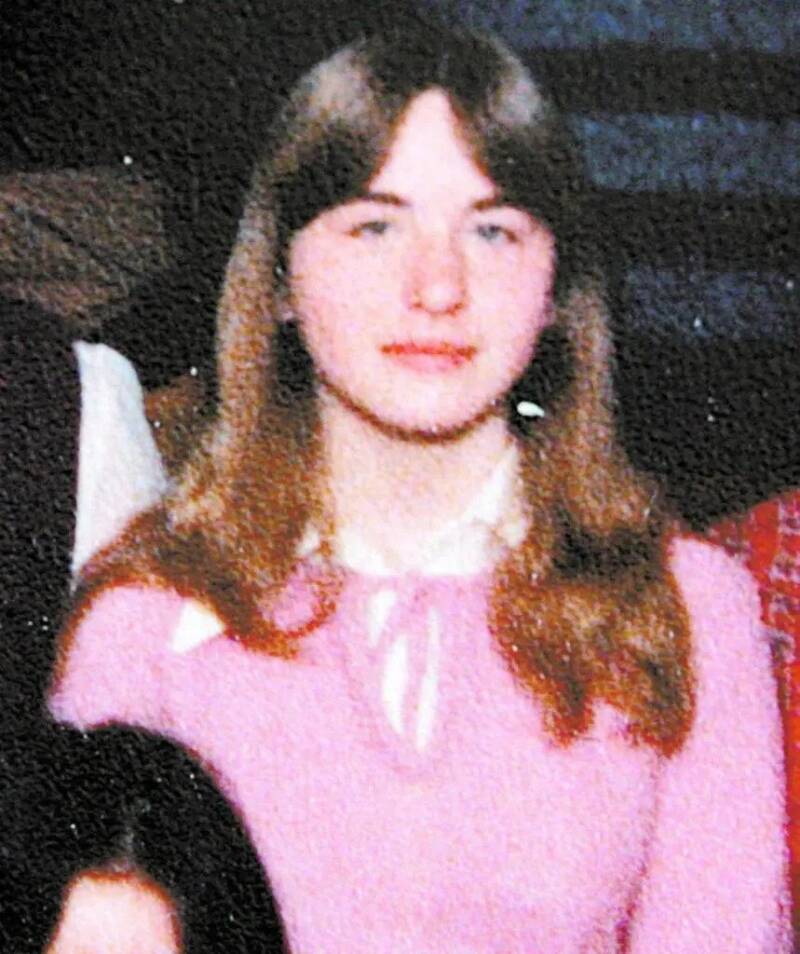
Elisabeth Fritzl at age 16, two years before her father Josef Fritzl imprisoned her in the family basement.
Her father Josef Fritzl told the policeman who came to the house that he had no idea where she would go, but that she likely joined a religious cult, something she had talked previously about doing.
But the truth was that Josef Fritzl knew exactly where his daughter was. In fact, Elisabeth Fritzl was about 20 feet below where the police officer was standing.
And for the next 24 years, before Elisabeth Fritzl finally gained her freedom in 2008, she was Josef’s prisoner, held captive in the family basement and repeatedly raped and abused by her own father.
This is the chilling story of Elisabeth Fritzl, “the girl in the basement.”
The Imprisonment Of Elisabeth Fritzl, The “Girl In The Basement”
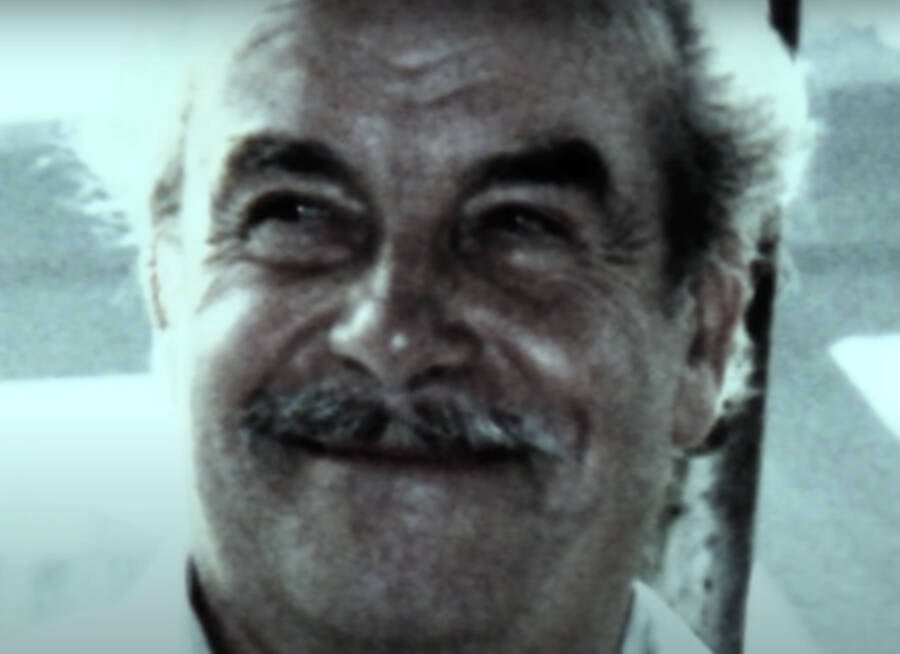
60 Minutes Australia/YouTubeJosef Fritzl managed to keep his imprisonment of his daughter Elisabeth, “the girl in the basement,” a secret for 24 years.
On August 28, 1984, Josef Fritzl asked his daughter to come into the basement of the family’s home. He was re-fitting a door to the newly renovated cellar and needed help carrying it. As Elisabeth held the door, Josef fixed it into place. As soon as it was on the hinges, he swung it open, forcing Elisabeth inside and knocking her unconscious with an ether-soaked towel.
For the next 24 years, the inside of the dirt-walled cellar would be the only thing Elisabeth Fritzl, “the girl in the basement,” would ever see. Her father would lie to her mother and the police, feeding them stories about how she ran away and joined a cult. Eventually, the police investigation into her whereabouts would run cold and before long, the world would forget about the missing Fritzl girl.

SID Lower Austria/Getty ImagesThe cellar home that Josef Fritzl built to keep Elisabeth in.
But Josef Fritzl wouldn’t forget. And over the next 24 years, he would make that very clear to his daughter.
As far as the rest of the Fritzl family was concerned, Josef would head down to the basement every morning at 9 a.m. to draw plans for the machines that he sold. Occasionally, he would spend the night, but his wife wouldn’t worry – her husband was a hard-working man and was thoroughly dedicated to his career.
Josef Fritzl Impregnates His Own Daughter
At minimum, Elisabeth Fritzl would be visited by her father in the basement three times a week. Usually, it was every day. For the first two years, he left her alone, keeping her captive. Then, he began to rape her, continuing the nightly visits he had begun when she was just 11 years old.
Two years into her captivity, Elisabeth became pregnant, though she miscarried 10 weeks into the pregnancy. Two years later, however, she fell pregnant again, this time carrying to term. In August of 1988, a baby girl named Kerstin was born. Two years later, another baby was born, a boy named Stefan.

YouTubeThe layout of the cellar where Elisabeth Fritzl was imprisoned.
Kerstin and Stefan remained in the cellar with their mother for the duration of her imprisonment, being brought weekly rations of food and water by Josef. Elisabeth attempted to teach them with the rudimentary education she herself had, and give them the most normal life she could under their horrific circumstances.
Over the next 24 years, Elisabeth Fritzl would give birth to five more children. One more was allowed to remain in the basement with her, one died shortly after birth, and the other three were taken upstairs to live with Rosemarie and Josef.
Josef didn’t just bring the children up to live with him, however.
How Elisabeth Fritzl’s Imprisonment Went Unnoticed For Years
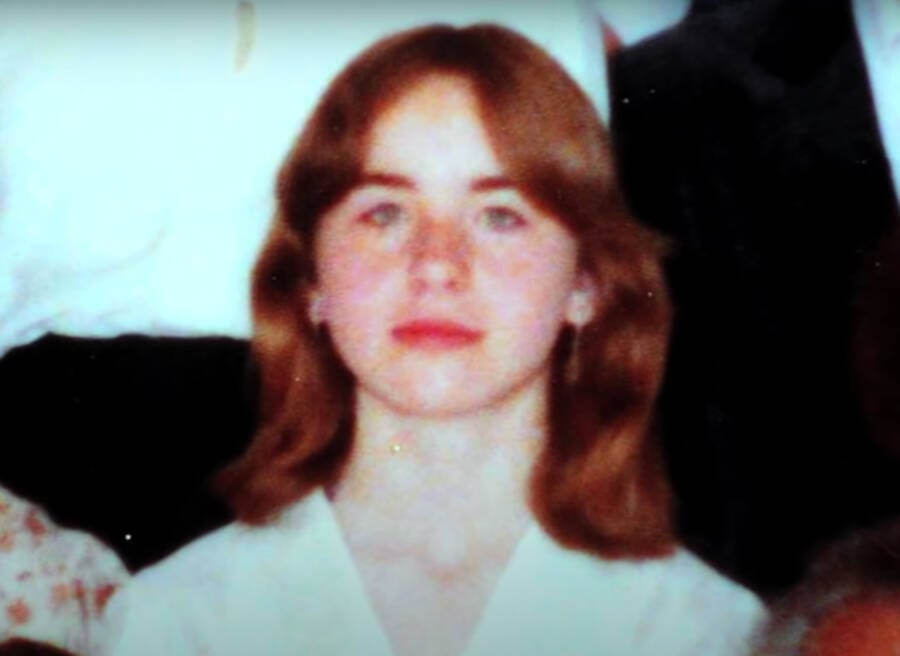
60 Minutes Australia/YouTubeFrom age 18 to 42, Elisabeth Fritzl was held prisoner by her father Josef, who raped her so repeatedly that she gave birth to seven of his children.
In order to conceal what he was doing from Rosemarie, Josef Fritzl staged elaborate discoveries of the children, often involving placing them on bushes near the home or on the doorstep. Each time, the child would be swaddled neatly and accompanied with a note allegedly written by Elisabeth Fritzl, claiming that she couldn’t take care of the baby and was leaving it with her parents for safekeeping.
Shockingly, social services never questioned the appearance of the Fritzl children and allowed the family to keep them as their own. Officials were, after all, under the impression that Rosemarie and Josef were the babies’ grandparents.

SID Lower Austria/Getty ImagesThe house at Ybbsstrasse 40 in Amstetten, Austria, where Josef Fritzl imprisoned his daughter Elisabeth Fritzl in a basement prison.
It is not known how long Josef Fritzl intended to keep his daughter captive in his basement. He had gotten away with it for 24 years, and for all the police knew he was going to continue for another 24. However, in 2008, one of the children in the cellar fell ill.
Elisabeth begged her father to allow her 19-year-old daughter Kerstin to get medical attention. She’d fallen rapidly and critically ill and Elisabeth was beside herself. Grudgingly, Josef agreed to take her to a hospital. He removed Kerstin from the cellar and called an ambulance, claiming that he had a note from Kerstin’s mother explaining her condition.
For a week, police questioned Kerstin and asked the public for any information on her family. Naturally, no one came forward as there was no family to speak of. The police eventually grew suspicious of Josef and reopened the investigation into Elisabeth Fritzl’s disappearance. They began to read the letters that Elisabeth had supposedly been leaving for the Fritzls and began to see inconsistencies in them.
Josef Fritzl’s Horrifying Crimes Come To Light And Elisabeth Gains Her Freedom
Whether Josef Fritzl finally felt the pressure or had a change of heart regarding his daughter’s captivity, the world may never know, but on April 26, 2008, he released Elisabeth from the cellar for the first time in 24 years. She immediately went to the hospital to see her daughter where hospital staff alerted police to her suspicious arrival.
That night, she was taken into custody to be questioned about her daughter’s illness and her father’s story. After making the police promise she never had to see her father again, Elisabeth Fritzl told the tale of her 24-year imprisonment. The story of “the girl in the basement” would now finally be revealed.
She explained that her father kept her in a basement and that she bore seven children. She explained that Josef was the father of all seven of them and that Josef Fritzl would come down during the night, make her watch pornographic films and then rape her. She explained that he’d been abusing her ever since she was 11.
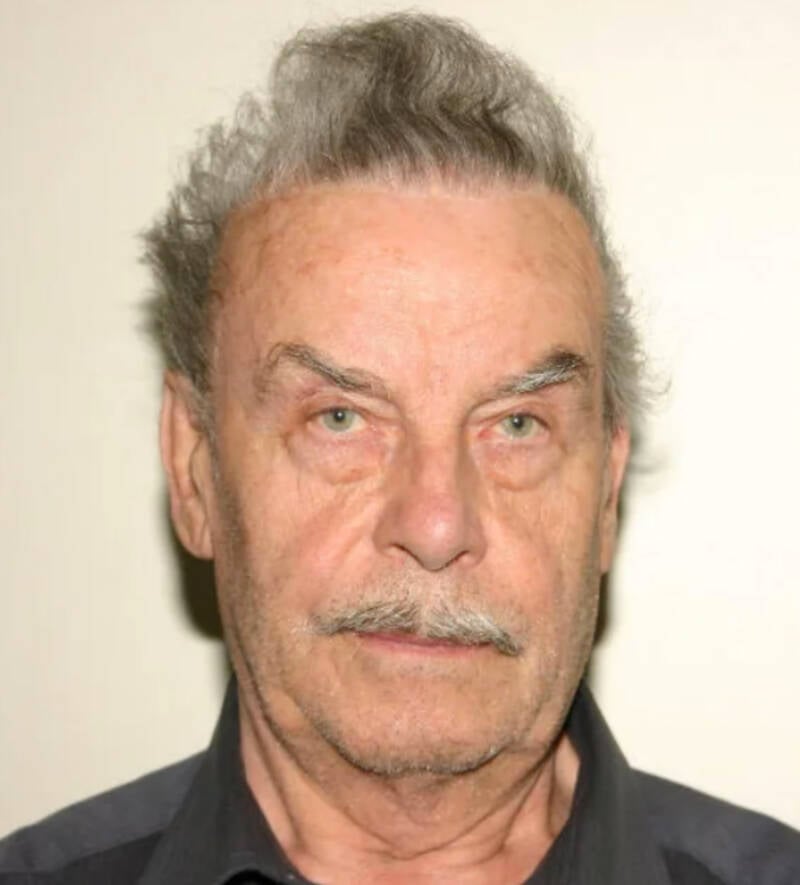
Public DomainFor 24 years starting in 1984, Josef Fritzl held his daughter Elisabeth Fritzl captive inside his basement prison at the family home in Amstetten, Austria.
The police arrested Josef Fritzl that night.
The Aftermath Of The Fritzl Case And The Fate Of Elisabeth Fritzl Today
After the arrest, the children in the cellar were also released and Rosemarie Fritzl fled the home. She had allegedly known nothing about the events taking place right under her feet and Josef backed up her story. The tenants who had lived in the apartment on the first floor of the Fritzl home also never knew what was happening right beneath them, as Josef had explained away all sounds by blaming faulty piping and a noisy heater.
Today, Elisabeth Fritzl, “the girl in the basement,” lives under a new identity in a secret Austrian village known only as “Village X.” The home is under constant CCTV surveillance and police patrol every corner. The family doesn’t allow interviews anywhere within their walls and decline to give any themselves. Though she is now in her mid-fifties, the last photo taken of her was when she was just 16 years of age.
The efforts to conceal her new identity were made to keep her past hidden from the media and let her live her new life. Many believe, however, that they’ve done a better job of ensuring her immortality as the girl held captive for 24 years.
After learning about Elisabeth Fritzl and her 24-year imprisonment at the hands of her father Josef that inspired “Girl In The Basement,” read about the Turpin family in California whose children were found locked in a basement. Then, read about Dolly Oesterreich, who kept her secret lover locked in her attic for years.
The post How Elisabeth Fritzl Was Imprisoned For 24 Years By Her Father appeared first on All That's Interesting.

Todd Williamson/Getty ImagesIn the true story behind Masterminds, David Ghantt and his accomplices stole $17.3 million during the October 1997 Loomis Fargo heist in Charlotte, North Carolina.
In 1997, David Ghantt was the vault supervisor for Loomis, Fargo & Co. armored cars, which managed the transportation of large sums of cash between banks in North Carolina. But even though he worked for a company that regularly moved millions of dollars, David Ghantt himself was underpaid. So he hatched a plan to rob his employers.
On October 4, 1997, David Ghantt and his accomplices grabbed $17.3 million from Loomis Fargo’s Charlotte vault, stuffed it into a van, and drove off.
As he later recalled about his life before the 1997 heist that changed his life forever and eventually became the true story behind the 2016 film Masterminds:
“Prior to, I would have never even considered it but one day life kinda slapped me in the face. I was working sometimes 75-80 hrs a week for $8.15 an hour, I didn’t even have a real home life because I was never there I was working all the time and unhappy which is understandable considering how old I was at the time. I felt cornered and one day the joking in the break room about robbing the place suddenly didn’t seem so far-fetched.”
So with the assistance of a co-worker and possible love interest as well as a small-time criminal, David Ghantt pulled off what was then the second-largest cash heist in U.S. history. Too bad for David Ghantt that it was poorly planned and that everything ultimately fell apart.
This is the full story of David Ghantt, the Loomis Fargo heist, and the true story behind Masterminds.
David Ghantt Plans The Heist Of A Lifetime
David Ghantt, a Gulf War veteran, had never been in trouble with the law. He was also married. But neither of those things would matter after he met Kelly Campbell.
Campbell was another employee at Loomis Fargo and she and Ghantt quickly struck up a relationship, one that Campbell denies was ever romantic though FBI evidence says otherwise, and one that continued after she left the company.
One day, Campbell was speaking to an old friend named Steve Chambers. Chambers was a small-time crook who suggested to Campbell that they rob Loomis Fargo. Campbell was receptive and brought the idea up to Ghantt.
Together, they came up with a plan.
While making only eight dollars an hour in his role as supervisor, Ghantt decided it was time to do something: “I was unhappy with my life. I wanted to make a drastic change and I went for it,” Ghantt recalled to the Gaston Gazette.
And drastic it was. In fact, David Ghantt was about to commit the heist of a lifetime.
How They Pulled Off The Loomis Fargo Heist
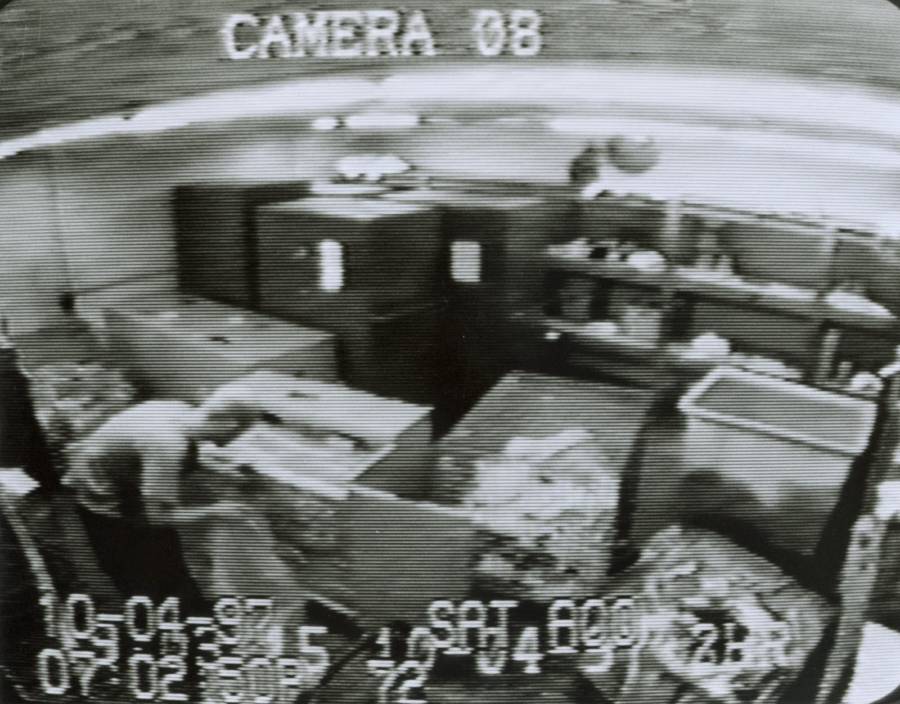
Retro CharlotteFBI security footage of David Ghantt in the midst of the Loomis Fargo heist.
Ghantt, Chambers, and Campbell came up with the following plan: Ghantt would remain in the vault after his shift on the night of the heist, Oct. 4, 1997, and let his co-conspirators into the vault. They would then load as much cash as they could carry into a van. Meanwhile, Ghantt would take $50,000, as much as could legally be carried across the border without questions, and flee to Mexico.
Chambers would hold on to most of the remaining cash and wire it to Ghantt as needed. Once the heat was off, Ghantt would return and they would split the haul evenly.
If you can see the obvious flaw in this plan, namely that Chambers would have no reason whatsoever to actually wire Ghantt any money, then congratulations. You’re better at planning bank heists than David Ghantt.
As it turns out, the heist did in fact go as well as you might expect.
The Problems Begin Piling Up For David Ghantt
On October 4, Ghantt sent home the employee he was training and disabled two security cameras near the vault in preparation for the heist. Unfortunately, he failed to disable the third camera. “I didn’t even know about it and overlooked it,” he said.
And so this third camera caught everything that happened next.
Ghantt’s accomplices soon showed up but now they had another problem. You see, there’s a reason Loomis Fargo used armored cars to move large amounts of cash. It’s heavy. And Ghantt hadn’t really thought about the physical challenge of moving such a large sum of money.
Instead, the bandits just started throwing as much money as they could into the van until they couldn’t fit anymore. Even though they drove away with less than they had initially intended, they still had more than $17 million in hand.
And with that, David Ghantt took off for Mexico.
When the rest of the Loomis Fargo employees showed up the next morning and found that they couldn’t open the vault, they called the police. Because Ghantt was the only employee who wasn’t there that morning, he became the obvious suspect.
That suspicion was immediately confirmed by a quick glance at the security camera footage that showed Ghantt doing a little dance after loading all the cash into the van.
Within two days, the investigators found the van with $3 million in cash and the security camera tapes inside. The thieves had simply abandoned whatever they couldn’t carry away. It was an open-and-shut case and all authorities had to do now was to find the culprit and identify Ghantt’s accomplices.
Campbell and Chambers made themselves easy to catch, what with their lavish spending. Chambers had known enough to insist that no one blows through a ton of cash immediately after the robbery, but once he actually had his hands on the money, he couldn’t follow his own advice. Chambers and his wife Michele moved out of a trailer and into a luxury mansion in a nice neighborhood.
But of course, then they had to decorate that spectacular new space and so they spent tens of thousands of dollars on things like cigar store Indians, paintings of Elvis, and a bulldog dressed up like George Patton.

Will Mcintyre/The LIFE Images Collection/Getty ImagesMichele Chambers’ 1998 BMW for sale following the prosecutions of the Loomis Fargo heist conspirators.
Chambers and his wife also made some cash payments on a few cars. Then Michele made a trip to the bank. She wondered how much she could deposit without attracting the attention of the FBI, so she decided to just ask the teller:
“How much can I deposit before you have to report it to the feds?” she asked. “Don’t worry, it’s not drug money.”
In spite of Chambers’ assurance that the money was, you know, totally not illegally acquired, the teller remained suspicious, especially because the stacks of cash still had Loomis Fargo wrappers on them.
She reported it immediately.
The Hit That Fell Short
Meanwhile, David Ghantt was relaxing on a beach in Cozumel, Mexico. He left his wedding ring behind and spent his days spending money on luxury hotels and scuba diving. When asked what the “dumbest thing was” that Ghantt spent money on, he admitted:
“The 4 pairs of boots I bought in one day [shrug] what can I say they were nice and I was impulse shopping.”
Naturally, Ghantt started to run out of cash and turned to Chambers, who was annoyed by his requests for more money. So Chambers decided to solve the problem by putting a hit on Ghantt.
Once the hitman Chambers had hired arrived in Mexico, he found that he couldn’t bring himself to kill Ghantt. Instead, the two started hanging out on the beach together and became friends.
Finally, in March 1998, the FBI traced a call from Ghantt’s phone and he was arrested in Mexico. Chambers, his wife, and several of their accomplices were arrested the next day.
The Aftermath Of The Loomis Fargo Heist And The True Story Behind Masterminds
In the end, eight co-conspirators were indicted for the Loomis Fargo heist. Because the money in the vault was largely from banks, the crime was technically a bank robbery and thus a federal offense. In total, 24 people were convicted. All but one of the indicted pleaded guilty.
Also charged were several innocent relatives that the robbers had enlisted to help get safety deposit boxes in various banks.
Ghantt was sentenced to seven and a half years in prison, though he was released on parole after five. Chambers served 11 years before being released. All of the cash from the Loomis Fargo heist was recovered or accounted for, except for $2 million. Ghantt has never explained where that money went.

Relativity StudiosThe Loomis Fargo heist was the inspiration for Masterminds, the 2016 film starring Zach Galifianakis as David Ghantt and Kristen Wiig as Kelly Campbell.
After his release, Ghantt took a job as a construction worker and was eventually brought on as a consultant for the 2016 movie Masterminds, based on the Loomis Fargo Heist. But because he still owes millions to the IRS, he couldn’t be paid. “I work construction. I’ll never pay it off on my paycheck,” Ghantt said.
Generally, the events of the film are fairly close to reality when they follow the broad details of the case. But as Ghantt admitted, the film took some liberties with specific details and characters to make the film funnier. Ghantt’s wife was reportedly nothing like the bizarre, robotic fiancée character in the film, for instance. There was also no dramatic showdown between Chambers and Ghantt as the movie suggests.
But thanks in part to the film, the outlandish story of David Ghantt and the Loomis Fargo heist will surely live on for years to come.
After this look at David Ghantt, the Loomis Fargo heist, and the true story of Masterminds, read about a more successful robbery, the Antwerp diamond heist. Then check out another bank robber who inspired a movie, John Wojtowicz.
The post Inside David Ghantt’s Infamous Loomis Fargo Heist In October 1997 appeared first on All That's Interesting.
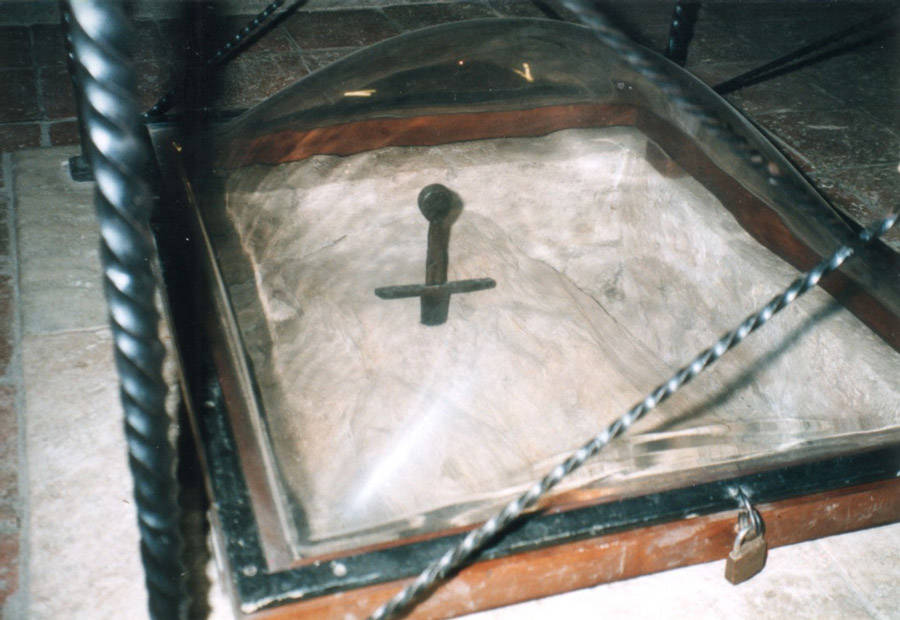
Giorces/Wikimedia CommonsThe “real sword in the stone” was purportedly thrust into this boulder by Galgano Guidotti in the 1180s.
Everyone knows the story of the future King Arthur pulling a sword from a stone, proving his worth as the ruler of England. But few are aware that there’s a real sword in the stone tucked away inside an Italian chapel.
As the legend goes, a medieval knight named Galgano Guidotti thrust his blade into a boulder on a hilltop in Tuscany after having a divine vision in the 12th century. Guidotti was later declared a saint, and Montesiepi Chapel was built around the stone where he performed his feat.
It remains on display today, with the knight’s sword still stuck inside. Other extraordinary stories surrounding the relic have emerged over the centuries, and religious pilgrims and curious visitors alike continue to flock to the chapel to see it for themselves.
This is the story of the real sword in the stone that has nothing to do with the mythic King Arthur.
Who Was Galgano Guidotti?
Galgano Guidotti was reportedly born to a feudal lord in Chiusdino, Italy, around 1148. He went on to become a wealthy knight, but while he was skilled in the art of combat, he was also profoundly arrogant, violent, and concerned only with worldly pleasures.
However, when Guidotti was in his early 30s, he had a vision. The Archangel Michael allegedly appeared to him and told him that he had to turn away from his life of sin. The angel led Guidotti to a hill, where the 12 apostles ordered him to give up all of his possessions and live as a hermit.
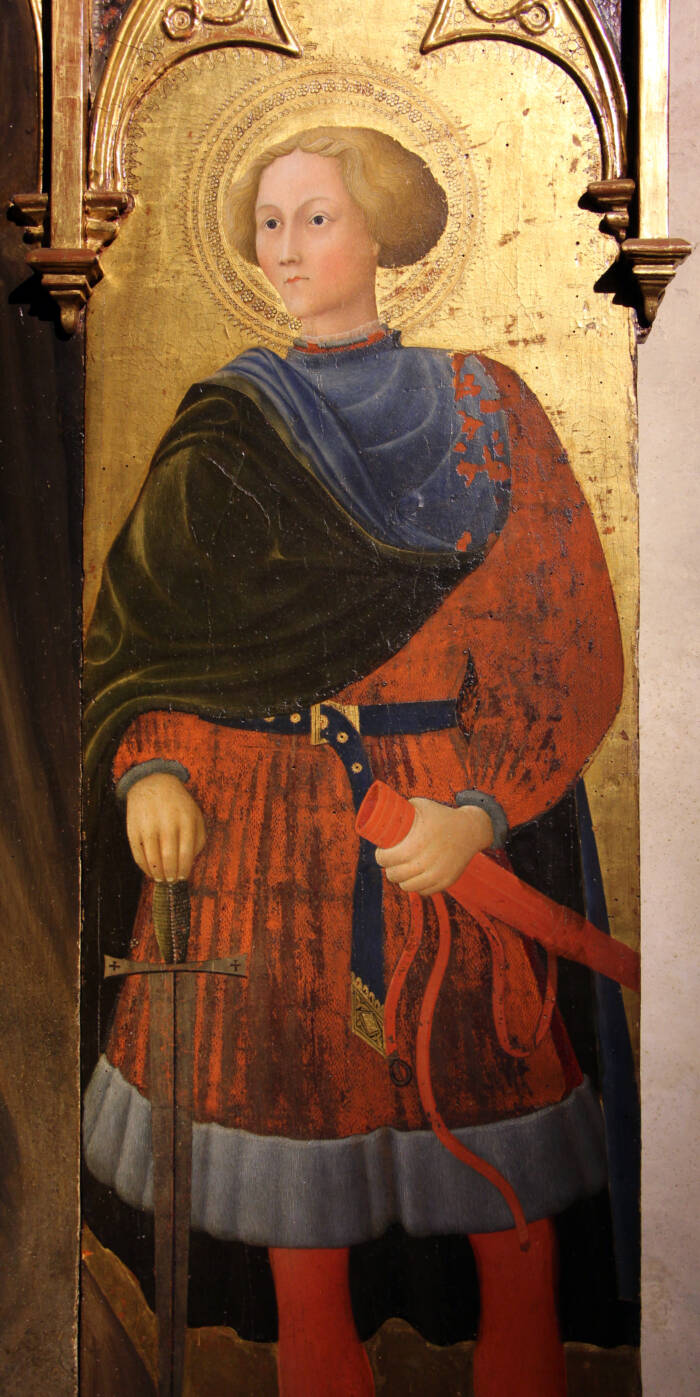
Sailko/Wikimedia CommonsA painting of Saint Galgano Guidotti, the knight who allegedly thrust a sword into a stone in the 12th century.
Guidotti told the apostles that it would be easier for him to split a rock with his sword than to adopt such a lifestyle. To prove his point, he thrust his blade into a nearby boulder — and it sliced right through.
When Guidotti awoke from his dream, he immediately changed his ways. He became a hermit, much to the surprise of his family. His mother didn’t believe Guidotti’s transformation was permanent, and she tried to set him up with a young woman so he could settle down and marry. Guidotti agreed to meet the potential love match, but on his way there, something strange happened. It would change Guidotti’s life — and the landscape of the Tuscan countryside — forever.
The Legend Behind Italy’s Real-Life Sword In The Stone
As the story goes, while Galgano Guidotti was heading to meet his potential fiancée, his horse suddenly changed direction. It led him to a hilltop that looked vaguely familiar, and Guidotti soon realized that it was the very hill that he’d seen in his vision.
To acknowledge the circumstances and honor God, he plunged his blade into a rock — and just as in his dream, it easily slid in. Only the hilt emerged, forming the shape of a cross.
The reformed knight died shortly after this incident, at some point in the early 1180s, but he spent his remaining days praising God as a hermit.
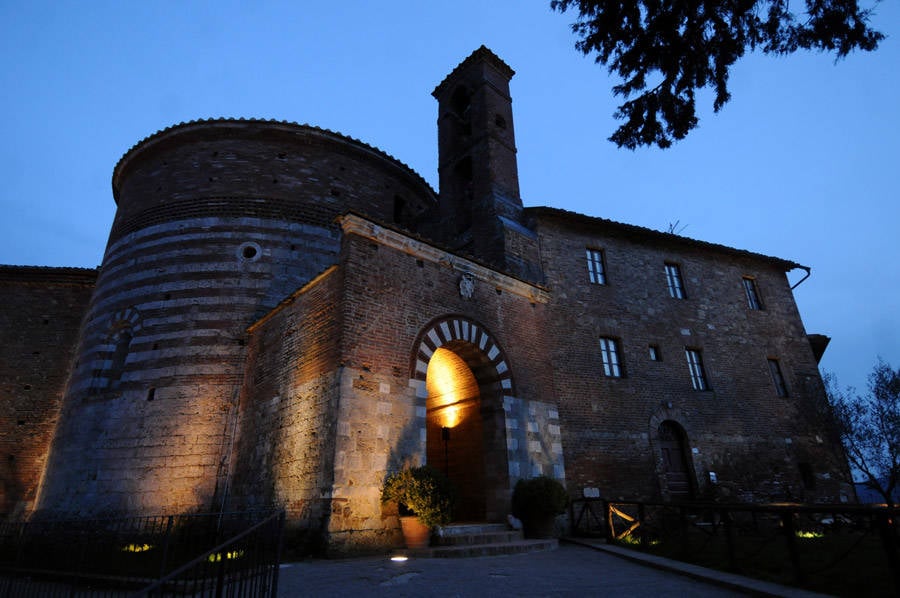
Eric VANDEVILLE/Gamma-Rapho/Getty ImagesMontesiepi Chapel was built over the “real sword in the stone” near Chiusdino, Italy.
Then, in 1184, Montesiepi Chapel was built around the real sword in the stone to memorialize Guidotti. Around the same time, he was canonized by Pope Lucius III, as pilgrims visiting the site had reported more than a dozen miracles after praying near the boulder.
The church has stood just outside of Chiusdino ever since. The Abbey of San Galgano, a Cistercian monastery, was constructed nearby in the 13th century. It was abandoned centuries ago, but its ruins — and the evidence of Saint Galgano Guidotti’s purported miracle within Montesiepi Chapel — can still be seen to this day.
Is The Real Sword In The Stone Legitimate?
In the centuries since Galgano Guidotti’s death, Catholic pilgrims have traveled to Montesiepi Chapel to see the saint’s sword for themselves. The stone that it’s lodged in sits in the floor in the middle of the church, though it’s covered in plexiglass to protect it from anyone who may try to pull the weapon from the rock.

Good Old Pete/Wikimedia CommonsThe interior of Montesiepi Chapel, with the sword pictured in the center of the floor.
Of course, skeptics have long questioned the legitimacy of the sword and the legend surrounding it. So, in 2001, scientists set out to settle the debate once and for all.
As reported by The Guardian at the time, researchers analyzed the blade and determined that it did indeed seemingly date back to the 12th century.
“Dating metal is a very difficult task,” said Luigi Garlaschelli, one of the study’s researchers, “but we can say that the composition of the metal and the style are compatible with the era of the legend. We have succeeded in refuting those who maintain that it is a recent fake.”
The scientists also used ground-penetrating radar to determine that there is an empty space in the ground beneath the stone, which may be the tomb of Saint Galgano Guidotti himself. What’s more, they looked into an additional myth related to the real sword in the stone — and discovered that it may be true, too.
Two mummified hands are also on display at Montesiepi Chapel, and there are two versions of the story behind them. One states that they belonged to a man who was torn apart by wolves while trying to pull the sword from the stone. The second claims that the wolves killed a man who was sent by the Devil to murder Guidotti while he was living as a hermit on the hilltop, mauling him so viciously that only his hands were left intact.
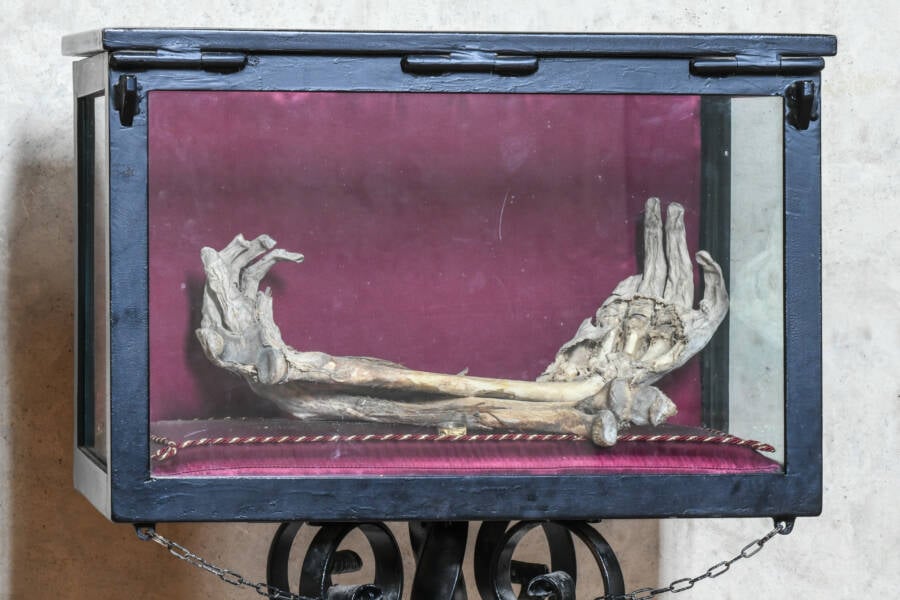
Bernhard Holub/Wikimedia CommonsThe mummified hands on display at Montesiepi Chapel allegedly belonged to a man who tried pull Galgano Guidotti’s sword from the stone.
Radiocarbon dating confirmed that the mummified hands were from the 12th century, just like the blade, lending some credence to the story of the real sword in the stone.
In the end, we will likely never know the true story behind the blade entombed in a boulder in rural Tuscany. But the legend of Saint Galgano Guidotti lives on as Italy’s very own version of the famed King Arthur.
After reading about Italy’s real sword in the stone, go inside the legend of Excalibur, the famed weapon of King Arthur. Then, learn the stories behind the Knights of the Round Table.
The post The Incredible Story Behind Italy’s Real-Life Sword In The Stone That Has Nothing To Do With King Arthur appeared first on All That's Interesting.
On April 1, 1990, a state trooper of the Arizona Highway Patrol Division spotted a tractor-trailer on the shoulder of the highway. He approached the vehicle to see if the driver needed any assistance.
What the trooper stumbled upon was a scene out of a horror movie.
Chained up inside the truck was a nude young woman with a gag over her mouth and a terrified look on her face. The truck’s driver, Robert Ben Rhoades, tried to explain that it was a private, consensual matter.

Public DomainBetween 1975 and 1990, Robert Ben Rhoades, a.k.a. the Truck Stop Killer, may have killed as many as 50 victims.
But the trooper wasn’t convinced and soon placed Rhoades under arrest. While waiting for backup, he discovered a .25 caliber automatic pistol in Rhoades’ possession.
At the time, Rhoades faced only kidnapping and assault charges. But as authorities would soon learn, Robert Ben Rhoades was actually one of the most dangerous sex offenders and serial killers in American history.
The Brutal Murders Of The Truck Stop Killer

Pinal County JailRobert Ben Rhoades’ mugshot from his 1990 arrest in Arizona.
Born November 22, 1945 in Council Bluffs, Iowa, Robert Ben Rhoades was in trouble with the law almost from the start. While in high school, he was arrested for tampering with a vehicle and then again for fighting in public before he joined the Marines.
Soon after, in 1964, his father was arrested for molesting a 12-year-old girl and committed suicide before the trial. A few years later, Rhoades himself was back in trouble with the law for a robbery that saw him dishonorably discharged from the Marines.
By the 1970s, Rhoades had found work as a truck driver. What the authorities learned much later is that, while out on the road, the Truck Stop Killer tortured, raped, and killed as many as 50 women. He even took photos of some of his victims before murdering them.
It’s presumed that his actual first murder happened long before, but Robert Ben Rhoades’ first confirmed murders happened in January of 1990. After he was arrested in Arizona in April of that year, he confessed to the murders of newlyweds Patricia Walsh and Douglas Zyskowski. The couple had left Seattle in November of 1989 and were hitchhiking to Georgia, preaching the Christian gospel.
The Truck Stop Killer picked them up in Texas and killed Zyskowski immediately. However, he held Walsh prisoner for more than a week, during which time he tortured and raped her repeatedly before shooting her to death.
Authorities found Zyskowski’s body near Interstate 10 east of Ozona, Texas later in January, though it wasn’t identified until 1992. However, it took almost 13 years for the authorities to identify Walsh’s remains after deer hunters found her body near the mouth of a canyon in Millard Country, Utah.
Committed soon after he dispatched the newlyweds, the crime that ultimately earned the Truck Stop Killer a life sentence was the rape and murder of Regina Kay Walters. The 14-year-old from Pasadena, Texas was hitchhiking with her boyfriend, Ricky Jones, when Rhoades picked them up in February of 1990.

Regina Kay Walters before Robert Rhoades cut off her hair while holding her captive.
Rhoades promptly killed Jones (whose remains were later found in Mississippi), but he kept Walters hostage for several weeks or more in what’s been called his “traveling torture chamber.”
Meanwhile, he took several photos of her as he held her captive. Photographic evidence seized during a search of Rhoades’ home revealed photos showing different lengths of Walters’ hair growth and various bruising, indicating that he held her for a substantial amount of time.
During Regina Kay Walters’ imprisonment, Rhoades would even call her father from payphones. On one call, he told Walters’ father that he cut her hair.

Robert Ben RhoadesOne of the last photos Robert Ben Rhoades took of Regina Kay Walters before killing the 14-year-old.
After torturing her with fishing hooks and other assorted instruments, Rhoades took one final set of photos of Walters just before killing her with a baling wire garrote. Afterward, he threw her body in a barn off of Interstate 70 in Illinois, where it was found in September. By then, the Truck Stop Killer had been in custody for about five months, but the book on his reign of terror was hardly closed.
Once Behind Bars, Robert Ben Rhoades Confessed To Even More Killings
Robert Ben Rhoades was convicted for Regina Kay Walters murder in 1994 and sentenced to life behind bars in Illinois, but authorities couldn’t get him for anything else for a long time. After he began serving his sentence, however, he started confessing to other murders committed during his long life on the road.
For one, he only faced consequences for the murders of Walsh and Zyskowski in 2012, more than 20 years after the crimes were committed. After a years-long pre-trial period, the Truck Stop Killer pleaded guilty to both murders and received another life sentence as part of a deal with prosecutors to avoid the death penalty.
According to District Attorney Steve Smith, “I’ve been a prosecutor since 1979 and it was one of the rare occasions when I was in the court where the defendant walked in and you felt the evil. The hairs on my arm stand up right now talking about it.”
Other prosecutors and cops who worked the Truck Stop Killer case over the years likewise felt Rhoades’ evil. Though such allegations have never been confirmed, the authorities widely suspect that Rhoades actually killed dozens of women.
Law enforcement cross-referenced his trucking logs with records of young women that went missing over a 15-year span when he was believed to be active, ultimately suggesting that he was responsible for some 50 murders, or as many as one to three women a month during his peak.
His truck was certainly equipped for the job. Authorities found a dungeon-like compartment between the seats as well as handcuffs on the ceiling so that victims could be chained and tortured. They likewise found a so-called murder kit containing chains, cords, whips, and leashes, as well as dildos and clips, pins, and fishhooks that he used on the genitals of his victims.
But without confessions or hard evidence, we may never know many people the Truck Stop Killer actually murdered during his bloody spree.
The Woman Who Got Away From The Truck Stop Killer

FacebookA photo of Pamela Milliken posted on Facebook by law enforcement.
While authorities suspect that there are dozens of unsolved murders hiding within Robert Ben Rhoades’ tale, one recently-surfaced story from his past had something of a happy ending.
In 2015, several law enforcement agencies shared a photo of a young woman taken by Rhoades inside his truck in 1985 on Facebook. It was on the same roll as the shots of Regina Kay Walters. The authorities figured the woman was another victim of the Truck Stop Killer and were looking to identify her.
But then, a woman from Saskatchewan named Pamela Milliken recognized the young woman as herself.
Milliken said that she was hitchhiking to go find her brother in Winnipeg when she ended up in Rhoades’ truck. When he snapped a photo of her just after she got in, she asked why and he told her that he kept photos of his passengers so that he could show them to the cops in case anyone ever robbed him and fled.
“He told me he was going to Florida, and he wanted me to come with him,” Milliken said. “At one point, he pointed to a sign on his dashboard that said ‘CASH, GRASS or ASS — No one rides for free,” she recalled. “I didn’t have any money. I didn’t smoke pot, so I knew which one it would be.” They had what Milliken described as a consensual sexual encounter and he dropped her off at a bus depot in Winnipeg.
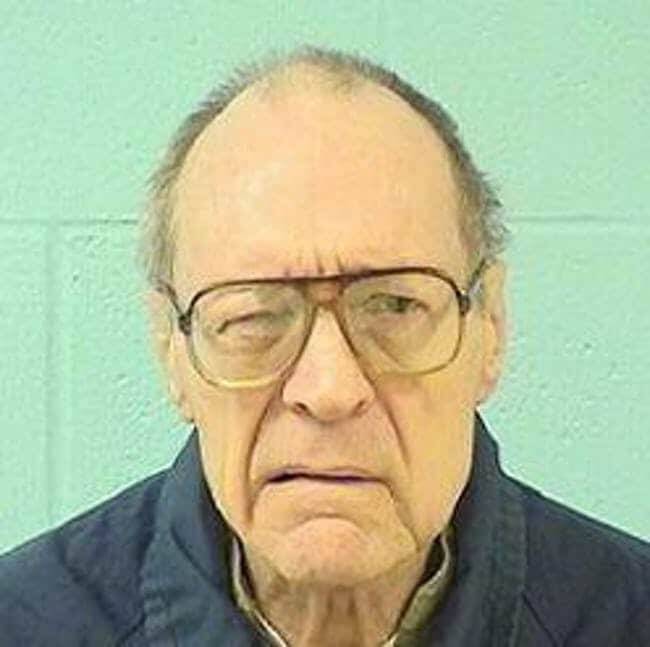
Public DomainNow more than 80 years old, Robert Ben Rhoades remains bars in Illinois today.
Of course, many were not as lucky as Milliken. And while the Truck Stop Killer will never see the light of day, we may never know how many lives he took.
Robert Ben Rhoades, now in his eighties, is currently serving his two life sentences without the possibility of parole at the Menard Correctional Center in Chester, Illinois. If there are more murder confessions to make, there may be time yet for other families to find some semblance of closure and justice.
Now that you’ve read about Robert Ben Rhoades, the Truck Stop Killer, learn about Olga Hepnarova, the truck-driving mass murderess. Then, discover the most notorious serial killers in history.
The post Inside The Brutal Murders Of Robert Ben Rhoades, The Truck Stop Killer appeared first on All That's Interesting.
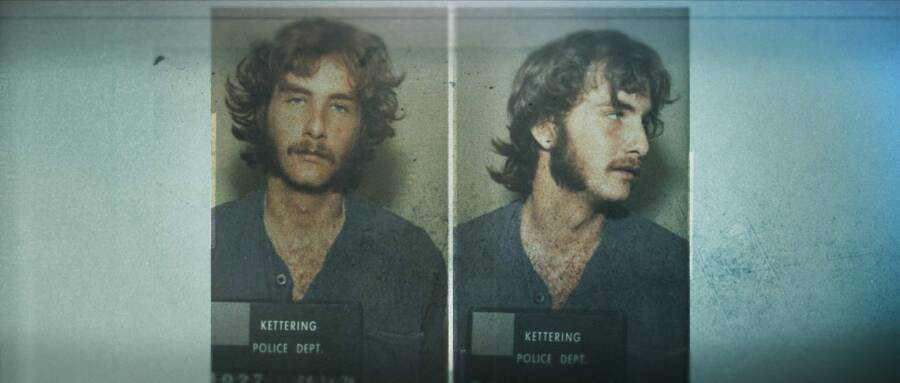
NetflixPsychiatrists initially identified 10 personalities within Billy Milligan — then later found an additional 14.
In October 1977, 22-year-old Billy Milligan was arrested for kidnapping, robbing, and raping three female Ohio State students. But what should have been a relatively straightforward conviction instead became a shocking acquittal. Milligan was found not guilty — because psychiatrists believed that two of his “other personalities” had committed the crimes.
During psychiatric evaluations, doctors found that “Billy” was just one of 24 personalities living in Milligan’s mind. Two of the others, Ragen and Adalana, they believed, had been the ones to kidnap and rape the women. Because of this, his lawyers argued that he was innocent by reason of insanity.
At the end of his trial, Milligan became the first person to be found not guilty by reason of insanity on the basis of multiple personality disorder (called dissociative identity disorder today). This condition is thought to come from extreme trauma and abuse early in life, which Milligan allegedly suffered.
So, was Billy Milligan a criminal or a victim? Could he have been both? The complicated nature of his case has been a point of fascination for nearly 50 years, but these questions are no less difficult to answer.
Billy Milligan’s Childhood Trauma
Born on February 14, 1955 as William Stanley Morrison, Milligan suffered significant trauma at an early age. His parents separated when he was young, and his father died by suicide when Milligan was around the age of four. Then, his mother married a man named Chalmer Milligan.
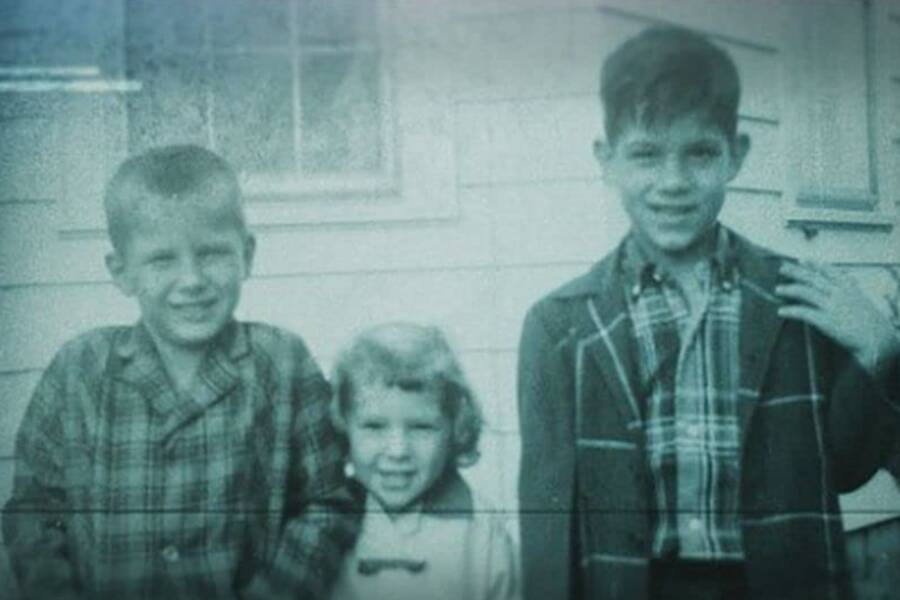
NetflixBilly Milligan (left) with his sister Kathy Preston and his brother James.
Milligan later claimed that his new stepfather severely abused him. Time reports that he sodomized Milligan and that he threatened to bury him alive or hang him by his fingers and toes if he told anyone.
Chalmer Milligan denied the allegations, saying: “I didn’t have time to do all those crazy things.” But Milligan’s mother and two siblings testified at his trial that Chalmer had been abusive toward Milligan. His sister even called the years that they lived with Chalmer “a horror.”
It was this abuse, some doctors later claimed, that caused Billy Milligan to develop multiple personalities. As the Columbus Monthly reported in 1979, psychiatrists studying Milligan came to believe that he’d developed multiple personalities as a way to cope with his stepfather’s abuse.
At that point, Milligan developed nine personalities, some male and some female, who were between the ages of three and 23. And, soon, some of them would start getting violent.
Billy Milligan’s Crimes As The ‘Campus Rapist’
On Oct. 14, 1977, Billy Milligan approached a young woman, an optometry student, in a parking lot on Ohio State University’s campus. He aimed a gun at her, then led her to a secluded area in the woods. Milligan raped her, then made her write and cash a check for him.
Eight days later, he raped a second victim. Then a third. And on Oct. 27, the day after Milligan’s third attack, one of his victims was able to identify him from a collection of mug shots.
It wasn’t the first time Milligan had been arrested — in 1975, Milligan was arrested for rape and armed robbery. His fingerprints on file matched a set found on one of the victim’s cars, and Milligan was arrested once again.
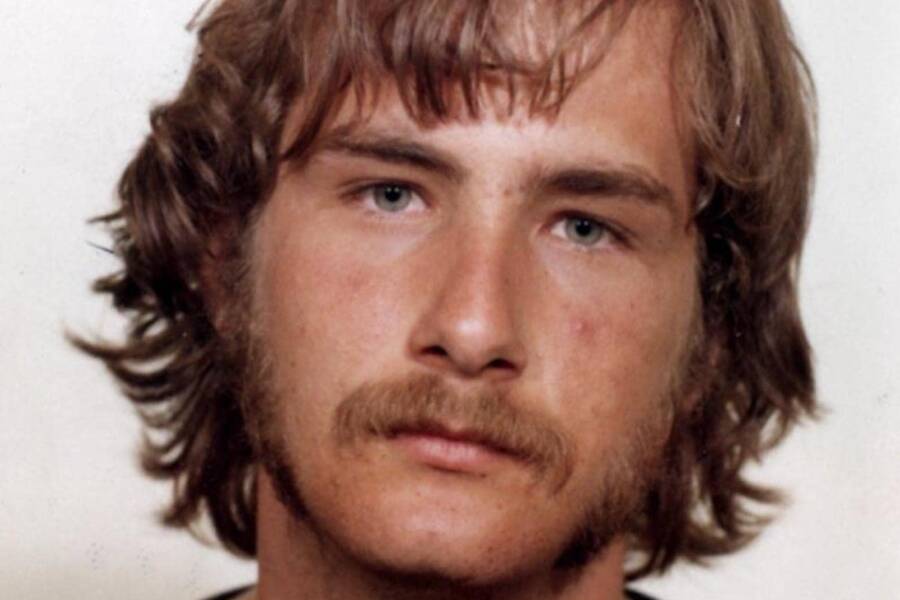
NetflixBilly Milligan’s victims reported that he spoke with several accents and told varying stories about who he was.
Then, investigators started to notice some odd things about Milligan. According The Columbus Dispatch, OSU police investigations supervisor Elliot Boxerbaum recalled, “I couldn’t tell you what was going on, but it felt like I was talking to different people at different times.”
Milligan’s victims also described how Milligan seemed to embody multiple personalities. He called himself Phil, claimed to be Jewish, and told one victim that he was a member of the Weathermen — later known as the Weather Underground, a far-left militant organization that claimed credit for 25 bombings in the 1970s. He also sometimes spoke with an accent.
Before long, a psychiatric evaluation would provide a surprising explanation for Billy Milligan’s odd behavior.
How Psychiatrists Determined He Had Multiple Personality Disorder
Psychiatrists first got a hint of Billy Milligan’s multiple personality disorder during his psychiatric examinations. As Time reports, a psychiatrist spoke with Milligan while he was in custody and called him “Billy.” Milligan, in response, said, “Billy’s asleep. I’m David.”
With this first piece of evidence, psychiatrist George T. Harding and psychoanalyst Cornelia Wilbur were called in to speak with Milligan. Wilbur was especially notable for her work with a woman named Sybil, another dissociative identity disorder (DID) patient with 16 personalities. In working with Sybil, Wilbur was able to successfully meld her personalities and their story was later turned into a book and a TV movie. (Though as A&E notes, Sybil later confessed that she’d made up her personalities.)
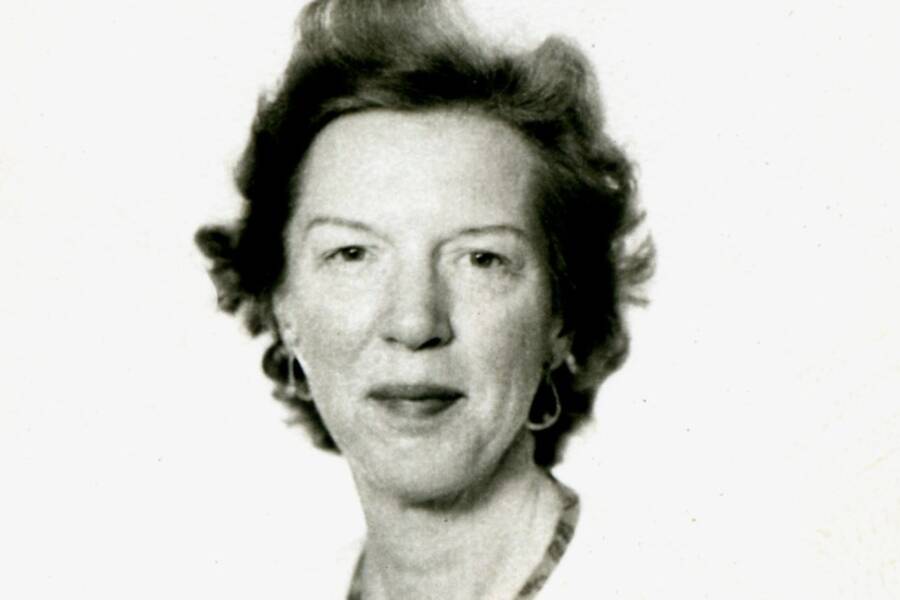
West Virginia & Regional History CenterPsychoanalyst Cornelia B. Wilbur, who courted fame and controversy over her “fusing” of Sybil’s personalities.
Harding and Wilbur determined that Milligan’s psyche had fractured into at least 10 different personalities, eight male and two female. They ranged from Christene, a three-year-old girl, to Arthur, a 22-year-old Brit, whose main task was cleaning up the other personalities’ messes.
But the two personalities that mattered most to Milligan’s case were Ragen, a 23-year-old with a Slavic accent who lacked empathy, and Adalana, a 19-year-old “curious lesbian.” According to Harding and Wilbur, it was Ragen who robbed the women and Adalana who raped them.
“Billy,” the psychiatrists found, was the core personality. He was suicidal and had strong feelings of guilt — and, they claimed, had been “asleep” for the last seven years. When Wilbur first met the “Billy” personality he told her, “Every time I come to, I’m in some kind of trouble. I wish I were dead.”
He and the other personalities allegedly had no memory of what Ragen and Adalana had done.
But not everyone bought Milligan’s multiple personality defense. In fact, even some in the medical field denounced the idea of “multiple personalities” outright, claiming, at best, that the term misrepresented the condition — this was actually part of the reason the condition was renamed to DID in 1994 — while others called it a fraud.
“Multiple personality is just a figure of speech. It’s nothing but a hoax,” said Thomas Szasz, a professor of psychiatry at the State University of New York in a 1979 interview with Columbus Monthly. “How many faces does Laurence Olivier or Elizabeth Taylor have? We are all actors. But there is only one person.”
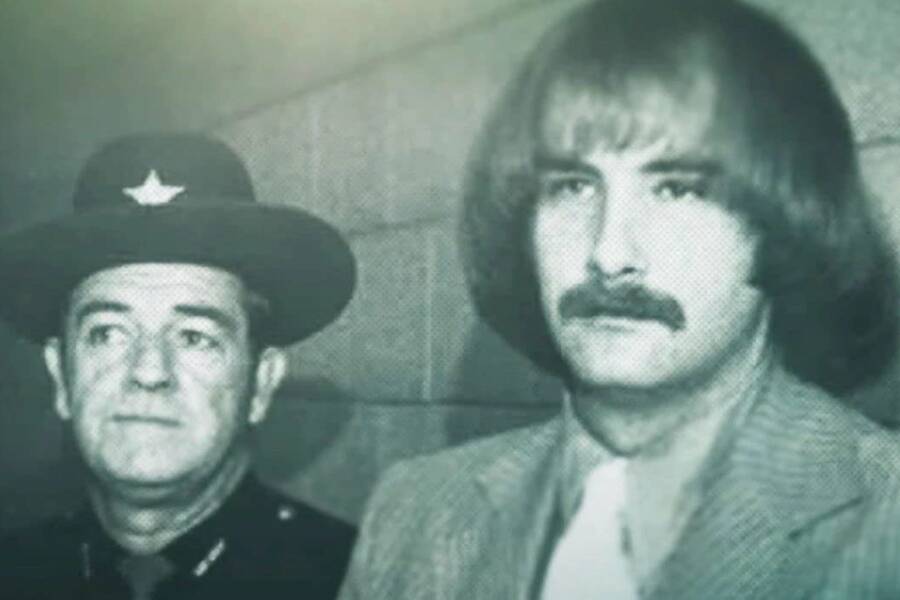
NetflixMultiple personality disorder was later renamed to dissociative identity disorder to help clarify what the condition actually is.
Others saw the label, and the defense’s use of it to plead innocence by reason of insanity, as an affront to the legal system. The case had, by and large, become more about Milligan’s psyche than it was about the women who had been raped. It also raised concerns about setting a legal precedent if Milligan were found not guilty, and psychiatrists additionally expressed concern about the public perception of DID.
Ultimately, a judge ruled that Milligan was “not guilty by reason of insanity” and had him committed to the Athens Mental Health Center. There, Milligan met psychiatrist David Caul, who wanted to “fuse” Milligan’s personalities.
Then, Caul found even more.
Billy Milligan’s 14 Additional Personalities And Hospital Transfer
During his attempts to fuse Billy Milligan’s personalities, Caul learned of another, The Teacher, to which Milligan had already fused himself. Caul drew The Teacher out by playing a recording of Ragen for Billy — the first time Billy heard proof of one of his other personalities.
Around this same time, in 1979, author Daniel Keyes, known for his work Flowers for Algernon, began interviewing Milligan to write his next work, The Minds of Billy Milligan.
But The Teacher didn’t stick around for long. Once word got out via The Columbus Dispatch that Milligan was being given unsupervised furloughs from the hospital following The Teacher’s appearance, the publicity caused Milligan additional stress, and The Teacher receded.
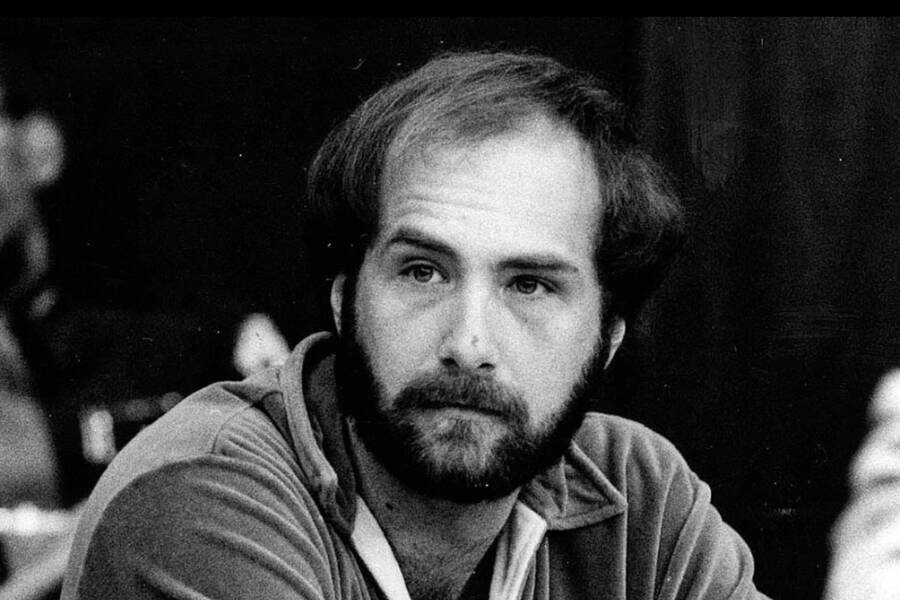
NetflixBilly Milligan briefly escaped from a mental hospital in 1986 and lived under the alias Christopher Carr.
In the wake of this, 14 more personalities emerged, and Milligan’s behavior made him a security risk for the hospital. On the order of an Athens County Common Pleas judge, Milligan was transferred to the Lima State Hospital for the Criminally Insane in 1980.
Milligan later described that hospital to Keyes as a “chamber of horrors.”
Throughout the majority of the 1980s, Milligan remained in psychiatric facilities, though he briefly escaped in 1986 (and may have murdered his roommate during that time). After several months of hiding and leaving video tapes for media outlets at the Greyhound station in which he complained about his hospital treatment, he was arrested in Miami.
Two years later, however, doctors came to the consensus that all of Milligan’s personalities had fused. After 11 years in mental hospitals, Milligan was released. Then, in 1991, he was released from all supervision.
For the most part, Milligan stayed out of the public eye after that. He lived on his sister’s property in Ohio, and in 2012 he was diagnosed with cancer. He died on Dec. 12, 2014 at the age of 59.
But Billy Milligan’s story didn’t die with him. Today, he continues to be an object of fascination (as proven by Netflix’s Monsters Inside: The 24 Faces of Billy Milligan in 2021). We all contain multitudes, but it’s a disturbing thought that parts of us could take over completely — and commit violent crimes.
For similarly shocking crime stories, read the story of Velma Barfield, the “Death Row Granny” whose psychiatrist tried to argue that she had also multiple personality disorder. Or, explore the twisted mind of “Jolly” Jane Toppan, the woman who tried to convince her doctors to kill with her.
The post Billy Milligan, The Serial Rapist Who Claimed That His ‘Other Personalities’ Committed His Crimes appeared first on All That's Interesting.
King Adolf Frederick ruled Sweden from 1751 to 1771, but he’s better remembered for his legendary death than for his 20-year reign.
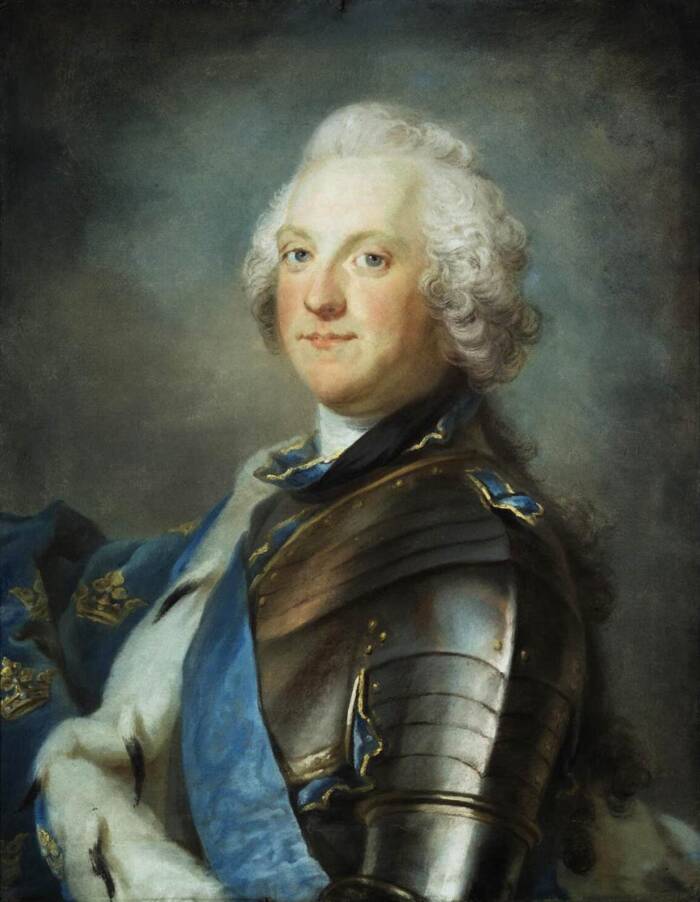
Public DomainAdolf Frederick was the king of Sweden from 1751 until his death in 1771.
The 60-year-old monarch suddenly fell ill on Feb. 12, 1771, after attending a feast for Fettisdagen, the Swedish equivalent of Fat Tuesday. He’d been in poor health for years and likely perished from heart failure or a stroke. However, rumors quickly began flying that he had eaten himself to death.
As the story goes, Adolf Frederick polished off his meal of lobster, caviar, and sauerkraut with 14 cream-filled buns called semlor. His intense stomach cramps started soon after, and he was dead within hours.
While there is no real evidence that King Adolf Frederick gorged himself into his deathbed, the legend persists to this day, and the Swedish royal will forever be associated with semlor.
The Uneventful Reign Of King Adolf Frederick
Born in the Duchy of Schleswig (located near the present-day border of Germany and Denmark) in 1710, Adolf Frederick was never meant to be king. His paternal grandfather was a duke, but his father’s older brother had inherited the title. Adolf Frederick himself had several older siblings, further separating him from any major positions of power. He ruled over a small fief, but he was nowhere near the throne — particularly not for a country he didn’t even live in.
However, Adolf Frederick’s mother descended from Swedish royalty. And his first cousin on his father’s side, Charles Frederick, married Grand Duchess Anna Petrovna of Russia, the daughter of Peter the Great. When Anna died in 1728 and Charles followed in 1739, a decade after Anna, Adolf Frederick became the administrator for their underage son, Charles Peter Ulrich.
Then, in 1741, Anna’s younger sister Elizabeth became the empress of Russia and appointed Peter Ulrich her heir. Around the same time, the Russo-Swedish War broke out. Russia ultimately emerged victorious, and Elizabeth wanted to ensure that an ally ruled Sweden. So, she essentially forced the Swedish government to appoint Adolf Frederick as the heir to the country’s throne by threatening to annex Finland if they didn’t.
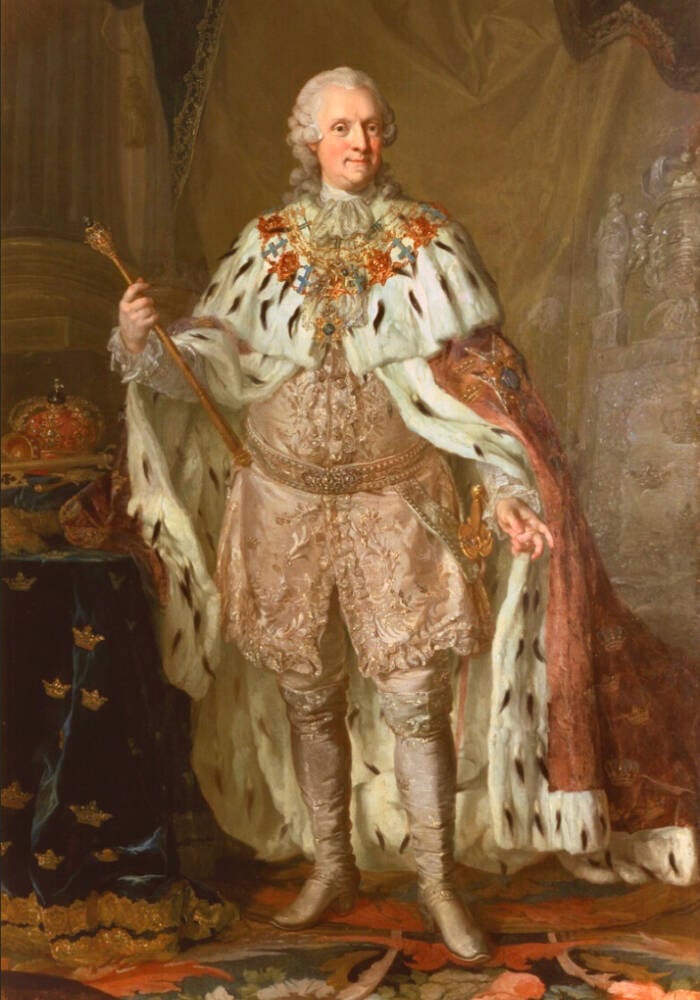
Nationalmuseum SwedenAn 18th-century portrait of King Adolf Frederick by Swedish artist Lorens Pasch the Younger.
Thus, when Frederick I died in 1751, Adolf Frederick became the king of Sweden.
Despite his title, however, Adolf Frederick was more of a symbolic figurehead. The actual ruling was done by the Riksdag, Sweden’s Parliament. He did try to overthrow the institution on two occasions, but he never completely succeeded.
Otherwise, King Adolf Frederick’s reign was largely uneventful — at least until his death.
The Fat Tuesday Feast That May Have Killed A King
In 1771, Ash Wednesday fell on Feb. 13, marking the beginning of Lent. That meant that Feb. 12 was Fettisdagen, which translates literally to “Fat Tuesday.” There was a feast at Stockholm Palace to celebrate the occasion, and King Adolf Frederick purportedly dined on seafood, duck, and a variety of vegetables, washing it all down with champagne.
Then, he turned to what’s said to have been his favorite dessert: semlor, also called hetvägg when soaked in hot milk. The sweet buns are filled with cream and traditionally served as part of the Fettisdagen meal. As the legend goes, Adolf Frederick ate 14 semlor before calling it a night.

Frugan/Flickr Creative CommonsSemlor are sweet buns flavored with cardamom, filled with an almond paste, and topped with whipped cream and powdered sugar. They are sometimes served in a bowl of warm milk.
Shortly after dinner, the king was gripped by a sharp pain in his stomach. As his postmortem report noted:
“His Majesty little more than three hours after the meal, which was strong and of steady food, was attacked by the most violent colic and spasms in the abdomen, which in haste also moved the head and brain… and thereby squeezed together the parts indispensable to life, and quickly concluded in a killing asphyxia, and perfect apoplexia serosa, to the greatest sorrow and loss of all the inhabitants of the Swedish Kingdom.”
The doctor also observed that the monarch’s stomach held “remains of food, partly melted, partly still in smaller pieces, which had not begun to transform,” and the “large intestines were mostly empty but congested with gases.”
Nothing in the autopsy report suggests that Adolf Frederick ate himself to death. In fact, the doctor noted that the king had been in poor health for years. Back pain, colic, severe migraines, hemorrhoids, constipation, diarrhea, and frequent severe colds all plagued the royal, suggesting there may have been an underlying gastrointestinal disease.
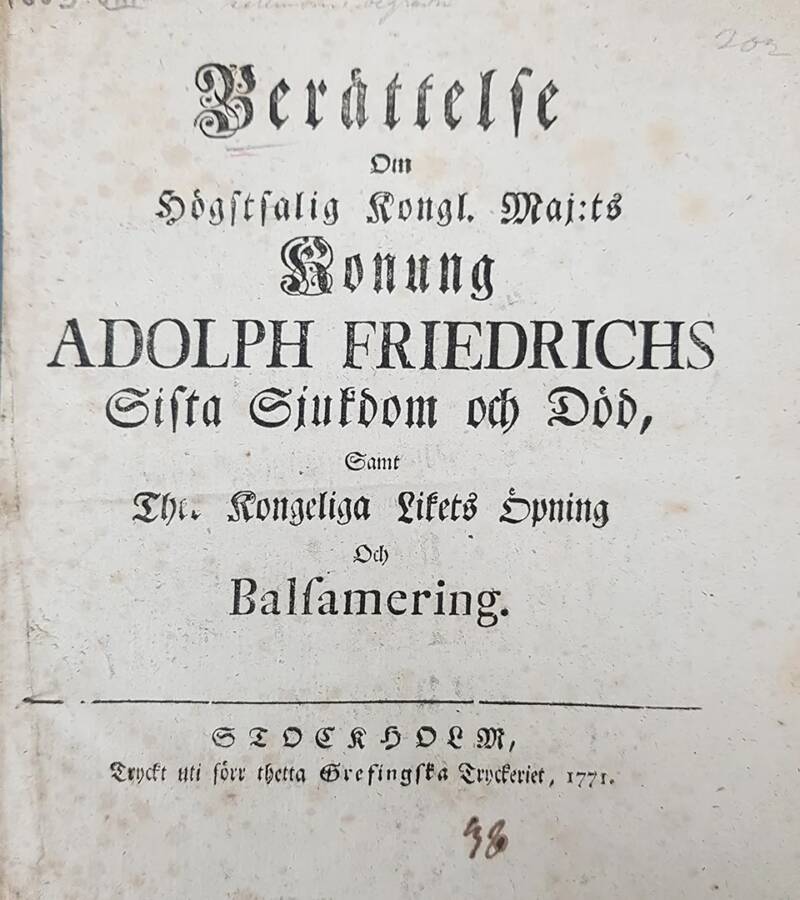
Public DomainThe post-mortem report of King Adolf Frederick.
It’s most likely that King Adolf Frederick died from a stroke or perhaps heart failure. So, why does everyone still believe that he ate himself to death?
How The Rumors About King Adolf Frederick’s Death Began
Shortly after Adolf Frederick’s death on February 12, 1771, Swedish poet Count Johan Gabriel Oxenstierna recorded in his diary, “His Majesty’s death has occurred from indigestion of hetvägg, sauerkraut, meat with turnips, lobster, caviar, duckling, and Champagne wine.”
It’s unclear exactly how the news of the king’s demise was reported to the public, but many modern scholars believe that the story that he gorged himself was spread as propaganda.
Adolf Frederick was buried at Riddarholmen Church in Stockholm alongside many more of Sweden’s monarchs. His son Gustav was in Paris at the time of the king’s death, but he returned to Sweden to address the Riksdag. He then successfully seized power from the Parliament, something his father had never been able to do.

Public DomainThree of Adolf Frederick’s sons, including King Gustav III (left).
This 1772 coup, known as the Swedish Revolution, ended the country’s Age of Liberty and expanded royal power. As King Gustav III, he abolished torture, introduced more religious freedom, and gave commoners the right to hold higher offices that they were previously banned from. Of course, this stirred discontent amongst nobility — and Gustav was killed by a group of disgruntled noblemen in 1792.
So, in the end, King Adolf Frederick’s death probably wasn’t as fascinating as it’s been portrayed — but it did pave the way for a new Sweden.
After reading about the life and death of King Adolf Frederick of Sweden, go inside 10 other weird royal deaths. Then learn the true story of Marie Antoinette’s execution.
The post The Bizarre Story Of King Adolf Frederick, The Swedish Monarch Who Allegedly Ate Himself To Death appeared first on All That's Interesting.