Feed: Atlas Obscura - Latest Articles and Places
Somewhere in Kansas, a well-traveled man asked me if I was driving long distances to hit the state's biggest attractions. I paused. That wasn't really how I was thinking about this trip at all.
As I settled into driving south to north through the plains states, I discovered something. Wonder doesn't actually require huge detours when you travel with the Atlas Obscura app. Wherever I was headed, there was something unexpected and interesting practically underfoot.
So I showed him.
I pulled up the app right there. “Look. Fifty feet from where we're standing, there's an all-electric house.” And just a few minutes away, a horse graveyard.
I had already failed to stop at Mister Ed's grave in Oklahoma, sorry Mister Ed, so I wasn't going to miss this one.
The Lawrin gravesite sits at the end of a quiet residential cul-de-sac in Prairie Village, a tidy suburb of Kansas City. It's tucked behind a black wrought-iron fence on a small, well-tended rectangle of green. You would never know to turn into this neighborhood, wind down its meandering streets, and pull up to this spot without Atlas Obscura.

But here's what's interesting about Lawrin.
He was the only Kansas-bred horse ever to win the Kentucky Derby. In 1938, Lawrin crossed the finish line with jockey Eddie Arcaro in the saddle and a four-leaf clover tucked under it for luck. The entire 200-acre Woolford Farms where he was born and trained is now Prairie Village. All that's left of it is this small, immaculate patch of grass at the end of a cul-de-sac.
While I was there, I met a man in his 90s who lives in the house across the street from the grave. He told me his favorite story about that 1938 Derby finish.
In the final stretch, he said, Lawrin and his jockey glanced back. The second-place rider was closing fast. They nearly lost.
But then they refocused and surged ahead.
“Never look back,” he told me. “When you turn around like that, the horse thinks it's coming to the end. He starts to slow down. Just keep going.”
Then he shared a bit of horse burial trivia. Racehorses are usually buried with only their head and heart because their bodies are simply too large.
Head and heart.
I turned that over as I walked back to my car. It turns out the full tradition actually includes the hooves too. Intelligence, spirit, and speed, all interred together.
And if there was one thing Lawrin had in abundance, it was speed. Two minutes and four and four-fifths seconds worth of it, to be exact.
That's what wandering with Atlas Obscura does for you. You stumble onto wonder in places you never would have found on your own.
If you have suggestions for places I should see in the states I still have left, email me at CEO@atlasobscura.com.
My map so far:


Rome is often called the Eternal City, but we may also call it the city of eternal rest. Its marble façades and jagged ruins are so many mausoleums for miles of entangled passageways where the dead have been laid down. The seven hills and the glowing marble of Bernini and Baroque decadence of the capital and the pillars, thick and solid, evoke a martial dream of grandeur and order. Beneath the city, another architecture binds the city: wending damp passages lined with the bodies of the dead, ancient and fresh. These are the bodies of a beloved sister, brother, father, mother, daughter, or son. Sometimes in discrete coffins, or in rectangles carved into the walls, neat as a sailor’s bunk.
There are many places to enter the underground Roman city. One entrance is in a small nunnery on the Via Salaria. To get there, you can take the metro or go on foot from the Palace of St. Peter, where cardinals gather and choose among their number the man to lead the Catholic World.
Off the Villa Ada Park, you can visit the sisters of Benedictine Order. Like many orders of monks and nuns, they participate in the current global market through the making and selling of traditional crafts. Their handwoven woolen table runners are a bargain made possible by the working sisters who expect no surplus income for their own personal use. The sales price barely covers the costs of the wool. Whatever small profit they do generate goes towards communal living expenses and basic repairs. The plumbing in particular urgently needs attention. The eighteen hours of careful work that go into weaving these table-top masterpieces go unrecorded in the ledgers the same way their rosaries and prayers dissolve into the air. God alone accounts for the sisters’ work.
The current members of the order are mostly an older bunch. Even if they were younger, it would be difficult to tell. White collars wrap the women’s faces rightly from their chins to their hairlines giving each of them a pleasing, anonymously oval face. No sister lives now that served the convent during the Second World War. Their bodies lie interred and, for the moment, completely intact in the graveyard next to the convent’s chapel. It is unclear if the tradition of digging up the bodies once the flesh has decomposed and reburying the bones in the catacombs will continue in light of recent health codes. But the sisters seem unconcerned. Death and storage have always been matters of practical discipline. They have complete faith in the Almighty’s ability, come Judgment day, to find and reassemble their bodies. In the meantime, they make do.
World War II is a proud moment in the order’s history. The Catholic Church did not formally condemn the Nazi regime, but many Roman Catholics, including Pope Pius XII himself, sheltered Jewish families. Likewise, the sisters objected to the NAZI policy on Jews and sheltered their fellow Romans. The nine-month Nazi occupation of Rome reached its pinnacle in October, 1943 when the Gestapo raided the city’s Jewish neighborhood and arrested more than 1200 people. In the subsequent months, another 600 Jewish individuals were arrested and deported. All 1800 were sent to Auschwitz. 16 survived. The Jewish population of Rome only persisted by going into hiding– and an estimated 11,000 did so.
One family of survivors were hidden and protected by the sisters of Villa Ada. After enduring cold, damp, terrifying and dull months underground, they lived to see the liberation of the city on June 4, 1944. Ten years later, to thank the sisters for their service, they commissioned a mosaic for the chapel above the entrance to the catacombs. The mosaic mimics of one of the most precious scenes from the catacombs below: A very, very early, probably second century, image of the Christian ritual of the Eucharist, wherein the priest, in imitation of Jesus at his final meal, or last supper, with his followers, breaks bread for the congregation to share in the ritual of Holy Communion.
The sisters gather daily to celebrate mass under the mosaic. Done in the style of the mosaics at Ravenna, this 1954 recreation evokes the ancient mediterranean eyes and flat style typical of catacomb art. The light catches the edges of glass to make the figures shine. At the far left, a bearded figure offers the bread of Christ to his brethren. Close your eyes and the outlines linger behind your eyelids: the image of these earliest brothers breaking bread in peace. After taking it in, you can go downstairs and see the original.
The catacombs smell cold: mildew, wet stone and the rot of clay earth and centuries of bones. In the dim light, you can see the original “Fractio Panis” faded after 1800 years to bare shapes and forms. It’s much smaller than the reproduction. It’s only ten inches tall. Look carefully, and you see the hair is different. Are those braids? Where are the folds of the toga? Each figure swells at the breast. Are these women? If they are, could they be celebrating the Eucharist without a male priest? Scholars have long been arguing about this fresco since it was rediscovered in 1894.
The images are faded enough that any suggestion has the power to shift your eye’s observation. Are your eyes playing tricks on you and making you see only men where there were women? Or do your eyes deceive you now that someone told you there are women there? In any case, what is unsure and impossible to verify, was made fixed and permanent by the artist of the 20th-century mosaic: The artists added a beard to the man breaking the bread and officiating the ceremony– which clears up any gender confusion immediately.
But take the time to visit the catacombs below and you will see a woman breaking the bread of the Catholic Eucharist. Is this evidence of women as church leaders in the early Christian Church?

This oddly formed sandstone pillar is located in the park next to Konin's oldest church, St. Bartholomew. The Latin inscription says it was erected in 1151 at the halfway point between Kalisz and Kruszwica.
Some scholars think that it's actually a much older pagan symbol which was "Christianized" with the inscription.

Hidden in the back wall of a courtyard of dragon statues, mystical wares, and spirits of the goddess, the library is a friendly space for anyone to peruse thousands of titles from two centuries, any and all literature with a subject related to knowledge outside the mainstream.
There are two large rooms of floor-to-ceiling books, on topics from occult and magic, to ancient history, wisdom and folklore, manned by volunteers and embracing all spiritual flavors of Glastonbury.
Friendly volunteers are enjoyable to speak with, and books are available for visitors to borrow overnight.

The Beale Street Hoodoo History and Folklife Museum is located on the top floor of the historic A. Schwab overlooking Beale Street in Memphis Tennessee. The museum boasts over 400 pieces of ephemera, art and artifacts related to African and African-American spiritual and healing traditions. Exhibits include:
Learn about Delta Blues musicians and the connection to Hooddoo culture.Look through the museum window and see the location where the Hooks Brothers studio took this famous studio photo of Robert Johnson in the 1930's. Learn about Hoodoo cultural language and it's coding within the Blues.
See photographs, documents and texts that tell the stories of the men and women who kept the tradition of healing and spiritual wisdom alive through slavery and segregation. Historically significant figures from Dr. Lyncha Johnson to Aunt Caroline Dye.
The museum features exhibits that tell the story of the roots of Hoodoo as born in the healing and spiritual traditions of Africa. Art, masks and artifacts from Africa help tell the story.
Visitors can see a recreation of a spiritual supply shop in the Delta. Antique furniture used on Beale Street to house spiritual supply products are used to exhibit a number of oils, powders, herbs and candles used in Memphis spiritual traditions.

Tours are on the first movable offshore drilling rig "Mr. Charlie." "Mr. Charlie" is the only authentic offshore drilling rig in the world available for the general public to tour. "Mr. Charlie" is the only National Historic Landmark representing the offshore oil and gas industry.
The guided tours are very informative and can last from 45 minutes to 3 hours (usually around 1 1/2 hours) depending on all the questions that are asked and answered. The tour guides are knowledgable, informative, personable, and helpful. They enjoy discussing the rig, the offshore oil and gas industry history and present, the surrounding area, and life itself.
It will be the best guided tour you have ever taken. Half of the tour is outside and half inside. There are several sets of stairs to ascend and descend, the first deck of the rig is approximately 40 feet above the river surface. Exhibits with the Diving and ROV Museum are included in the tour. Also, pets are welcome on the tour.
The Atlas Obscura map led me to two places in the same corner of northeast Oklahoma on the same afternoon. I didn't plan it as a journey from joy to grief. But that's what it became.
The first stop was Commerce, Oklahoma, population around 2,400, a town so modest you could drive through it in under two minutes and think nothing of it. I pulled up to 319 South Quincy Street with my eleven-year-old son, and we got out of the car into the bright afternoon and stood there in front of a small white house, taking it all in. This is where Mickey Mantle grew up. The Commerce Comet. One of the greatest baseball players who ever lived.
I told my son the story the way it deserves to be told: like a fairy tale. Mickey's father, Mutt, was so certain of his son's destiny that he named him after a Hall of Fame catcher before he was even born. When Mickey was a boy, Mutt would come home from work every afternoon at four o'clock, and the baseball lessons would begin. Mutt pitched right-handed. Mickey's grandfather pitched left-handed. They engineered a switch-hitter on purpose, right there in that yard. Below the windows was a single. Above them, a double. The roof, a triple. Clear the house entirely and you had a home run. Mickey once said he was "the only kid in town that didn't get in trouble for breaking a window."
My son and I walked around the yard. We peered into the old tin shed that served as Mickey's backstop. We stood where Mickey stood, and I tried to explain what it meant, that from this unremarkable house on this unremarkable street, in a small town most people have never heard of, something extraordinary grew. That greatness doesn't wait for the right zip code or the right circumstances. That you can come from anywhere, from very little, and still become something magnificent. A Yankees center fielder even. He nodded. We skipped around the yard a little, goofing off in the way that eleven-year-olds do when something connects with them but they don't quite have the words for it yet.
We got back in the car. I told him our next stop was just up the road. I knew it wouldn't be a happy place. Atlas Obscura’s entry about the town of Picher had made that clear.
We drove north on the small Highway 69, past flat green fields and bare trees, and then the landscape began to change. Gray mountains appeared, massive, looming, wrong. These were the chat piles: seventy million tons of toxic mining waste, the crushed and poisoned remnants of a century of lead and zinc extraction. As we rolled slowly into Picher, I was livestreaming on Instagram. Almost immediately, a viewer from Oklahoma appeared in the comments, urgent, almost scolding: Why are you going there? There are so many nicer places to visit. I kept driving deeper into the toxic town.
The houses came into view. Deserted. Every one of them. "KEEP OUT" spray-painted across doors and windows, faded but legible. Yards still faintly shaped by the people who had tended them, a walkway here, a porch railing there, the ghost of a garden. This didn't feel like some picturesque old mining ghost town from the 1880s, the kind you visit out west with a gift shop nearby. Picher had been a living community until very recently. In 1983, the EPA designated it part of the Tar Creek Superfund Site, one of the most toxic places in America, it turned out, surpassing even the Love Canal. By the mid-1990s, studies found that 34% of the children in Picher had dangerous levels of lead in their blood, a contamination that could cause lifelong neurological damage. An Army Corps of Engineers study in 2006 found that 86% of the town's buildings were badly undermined by mine shafts and at risk of sudden collapse. Then, in May 2008, an EF4 tornado tore through what remained, killing six people and destroying 150 homes. The government stopped offering to help people rebuild and started offering to pay them to leave. By June 2009, the last residents had accepted buyouts. On September 1, 2009, Picher was officially dissolved as a municipality. Sixteen years ago.
That's what I kept thinking. Sixteen years ago, people lived here. Children played in these yards. A high school class graduated — eleven seniors, the last class in Picher-Cardin High School's history — and then the doors closed forever.
"Can we go faster?" my son asked. "Can we leave?"
We stayed in the car. I didn't roll down the windows, having read on Atlas Obscura that the wind could carry harzardous material. I told my son what I tell myself about travel: that it's not just about the beautiful places and the perfect photos. It's about seeing many angles on the world, including what's hard and strange and broken. And that we owed it to the people who lived here not to look away.
He nodded again. Less convinced this time.
Picher stayed with us for days afterward. We kept talking about "that toxic town." And, honestly, I couldn't decide what to share about it with Atlas Obscura's community. Should I even write about it?
Then, I sat down to write about Mickey's house in Commerce. I was writing the story about the balls thrown over the house with his father, and I looked up more about Mutt. Wow. Mutt died in 1952, at forty years old, when Mickey was twenty. The cause was Hodgkin's disease. Mutt's father Charlie, the same man who had pitched left-handed to Mickey in that yard every afternoon, had also worked in the mines of northeast Oklahoma and also died of Hodgkin's disease before he was fifty. Mickey spent his whole life assuming it was family fate — that the Mantle men simply didn't make it past forty. He didn't know, until much later, that inhaling lead and zinc dust in the mines can lead to Hodgkin's disease. Mutt had worked specifically at the Eagle-Picher Company, the mining operation whose waste became the toxic mountains I had driven through that same afternoon, a few miles up the same road.
And here is what stopped me cold when I worked out the timeline. The Eagle-Picher mines didn't close until 1967, fifteen years after Mutt was already dead. The EPA didn't declare the area a Superfund site until 1983, thirty-one years after Mutt died. And the last residents weren't cleared out until 2009, fifty-seven years after Mutt's death. The mine that in all likelihood killed him, just kept going. More workers. More families. More dust. And the town built on top of all that poison wasn't fully evacuated until more than half a century after Mutt Mantle was buried. When all that happened, people weren’t talking about Mutt Mantle or the connection the mine had to the famous Yankee’s baseball star.
Today, most people who make the pilgrimage to Mickey Mantle's boyhood home in Commerce never drive the few minutes north to Picher. Why would they? Mickey's house draws baseball fans and history lovers who want to stand where a legend stood. They skip around the yard, peer into the old tin shed, feel the warmth of the American dream — and then they get back in the car and drive away, the story intact, the fairy tale complete. But the full story isn't in Commerce. It's also in the journey to Picher. Until you've sat in that toxic town and felt the eerie silence of those deserted streets, you haven't really understood what it meant for Mutt Mantle to come home from work every afternoon at four o'clock.
"That's so sad," my son said, when I told him that Mickey’s father worked there.
"Are you okay that I took you to Picher?" I asked him.
He thought about it for a moment. Then he nodded, slowly, solemnly, a little wiser.
Wonder, I've come to believe, isn't only the beautiful and the marvelous. Sometimes it's the terrible thing you finally understand. Sometimes it's the two places on the map that turn out to be, quietly, the same story.

Japan is the a country filled with shrines dedicated to various things and entities. Some are big, and others as small as a single sign. But very few are run by vending machines.
The Enkiri Enoki shrine is dedicated to an ancient tree from the Eddo period which is said to help with the breaking of bad relationships and the beginning of new ones. This makes it a popular spot with people who want help with their relationship, and also alcoholics who want to stop drinking. However, the place is too small for round the clock shrine keepers, and thus an alternative was found; vending machines.
There are two of them on it's small premise. A large machine that sells 'Ema' planks which are used to write down your wish, and a smaller 'gachapong' machine which dispenses blessed charms for those who wish to cary them. This unique system makes the temple easy to use with minimal upkeep from priests.

In the commercial and political center of Lusaka lies a green space, across the street from the Cabinet Offices and surrounded by embassies. This park is the official cemetery for the presidents of Zambia. Ever since gaining independence from Great Britain, Zambia has been fortunate to have relatively peaceful and regular transitions of power, with generally free and fair elections with minimal violence and no serious coup attempts. The current president, Hakainde Hichilema, is Zambia's seventh president (not including Guy Scott, Zambia's caretaker president for three months in Oct 2014 and Africa's first leader of European descent since the fall of apartheid.)
Today, five of Zambia's deceased presidents are buried here, including the first president and father of Zambian independence, Kenneth Kaunda. Each is intended to have their own mausoleum - each specifically designed to represent the values and legacies of their respective occupants - although currently only three have been built. The remaining two are in stages of planning, including Kaunda's, the most recent of these leaders to pass away.
As of early 2026, there is one notable absence, and an empty grave to mark it. President Edgar Lungu died in a hospital in Johannesburg in June 2025, but arguments over his funeral proceedings continue to the present day. Visitors can see the planned location and constructed tomb for Lungu, but his body remains in South Africa for the foreseeable future. Still, tours of the site provide visitors with a background on Zambia's executives, and the chance to pay respects to the most important men in the country's history in one convenient spot.

The Catacombs of Kom El Shoqafa were created sometime in the 2nd century CE as a familial necropolis for Alexandria’s upper class. The catacombs consist of several underground chambers containing numerous sarcophagi.
The complex exemplifies the diverse traditions of one of the Roman Empire’s most important metropolises, blending Egyptian, Greek, and Roman artistic styles to create one of the most unique and striking necropolises of the period. The catacombs contain a remarkable number of reliefs and tombs carved directly into the limestone bedrock. This includes the stunning main entrance, flanked by two depictions of the Egyptian god Anubis dressed in Roman military regalia.
Some tombs within the complex still retain traces of their original paint. Distinct scenes appear throughout the complex, including depictions of mummification alongside a Hellenic-style representation of the Abduction of Persephone. The catacombs feature extensive decorations incorporating Egyptian plants such as papyrus and lotus, Greek columns and mythological figures, and Roman iconography, with these three traditions frequently blending into artistic fusions that could only have emerged in a city like Alexandria.
The complex also includes the Hall of Caracalla, named after Emperor Marcus Aurelius Antoninus, which is believed to have been used for mass burials, possibly including the remains of individuals executed during his reign.

With a resemblance to the famous Abraham Lincoln statue in the Lincoln Memorial in Washington, D.C., this imposing statue at the Bell Telephone Company office in Brantford surprises many passersby.
Alexander Graham Bell invented the telephone at his family's house in Brantford and made the first long-distance call there as well. This statue is one of several monuments in "The Telephone City" dedicated to Bell.
The building isn't open to the public, but you can see the larger-than-life Alexander Graham Bell from the street.

Set along the beautiful, tree-lined banks of the Brisbane River, this heritage-listed artifact is a reminder of the history of the area.
The demountable cast iron tower was manufactured in 1912 by Robert Dempster & Sons Ltd, of Elland, Yorkshire, and transported in segments to Brisbane, where it was erected at the West End Gasworks in Montague Road operated by the South Brisbane Gas & Light Company.
The tower was used in the removal of tar and ammonia from raw coal gas by Gas Stripping. Gas was piped into the base of the tower, from where it rose to the top via a series of internal baffles over which water was sprayed from a header tank at the top of the tower, stripping the gas of coal tar and ammonia in the process. The liquid was drained via a water seal at the bottom, and sold as ammonia liquor.

St Oswold, king of Northumbria, wanted to spread the new religion of Christianity across the country. He consulted the monastic society of Iona to aid him in this. The monks sent Saint Aiden to establish a monastery in Lindesfarne and a church in Bamburgh. A forked beam in the roof above the font is said to be the original from this timber church. Legend has it that St Aiden was leaning against it when he died in the 7th century!
At the back of the church is a beautiful automaton dramatising the legend of the poor asking King Oswold for alms. The king went a step further, gifting the poor the silver plate to be broken up among them. St Aiden, who was also in attendence was so moved that he grasped the king's hand and declared, "May this hand never perish!" Bede asserts that this was, in fact, the truth. In his day, the king's hand (which had been severed in his last battle) was preserved in Bamburgh Church.
The building still standing dates back to the 12th century when Henry I granted permission to a priory in Yorkshire. Work began a century later to rebuild in stone.
Remarkable things to be seen in this church include the original "squint"- a square window overlooking the chancel, a space too holy for lay people to set foot in. The squint allowed them to glance at the altar and the priest leading the service.
The chancel itself is a sight to behold, with the memorial of the Forster family. The family of the remarkable Dorothy Forster, who performed one of the most iconic prison escapes in British history by disguising her husband, a Jacobite imprisoned in Newgate, as her maid and escaping unnoticed by the guards.
The church also holds memorials to the Sharpe family, the philanthropic family who ran Bamburgh Castle as a charitable community centre. Dr Sharpe established a cheap shop allowing villagers to buy wax, corn and other essentials cheaply, as well as schools for boys and girls, providing chances of employment.
In addition, the church is home to the memorial of the Victorian Heroine Grace Darling, who braved the North Sea to rescue shipwrecked sailors, becoming entrenched in legend. Grace Darling is also remembered in an exquisite stained glass window honouring formidable women, including Elizabeth Fry, a pioneer in prison reform and Florence Nightingale.
Take a moment to reflect on the countless memorials in the space, many of which are reminders of the deadly nature of the North Sea.
Outside the church, steps lead down to the crypt, which, via a viewing platform, allows you to catch a glimpse of the ossuaries, which are the final resting place for the hundreds of Christian Saxons buried in a cemetery by the castle. This cemetery was disturbed by a storm in 1817 and laid to rest in 2016 in the crypt.

The gray concrete giant seems out of place on the elegant Reinhardtstrasse. Expensive restaurants, hotels, booksellers, and the Berlin headquarters of the FDP (Free Democratic Party) define the surrounding cityscape.
The Reichsbahnbunker, built between 1942 and 1943 by forced laborers under the orders of Nazi authorities, was originally intended as a shelter for up to 2,500 Reichsbahn passengers. Its floor plan and exterior structure resemble a freestanding Renaissance-style palazzo; Albert Speer was involved in the planning, as the building was meant to be integrated into the "World Capital Germania" following the "Final Victory." That never came to pass.
After World War II, the bunker served a wide variety of functions, including a military prison, a clothing depot, a storage facility for tropical fruits, and—most recently—a techno and fetish club. Following its closure in 1996 due to drugs and excessive hedonism, it stood empty until 2003, when the publisher, media entrepreneur, and contemporary art collector Christian Boros acquired it and converted it into a private museum and his personal domicile.
The exhibition Boros #1 ran from 2008 to 2012 and drew 120,000 visitors, while Boros #2 (2012–2016) saw 200,000; currently, Boros #4 is on display. Contemporary works by Wolfgang Tillmans, Olafur Eliasson, Ai Weiwei, Klara Lidén, and many others have been and continue to be showcased here.
The conversion of the labyrinthine interior must have been complex and costly, lasting a full five years. Intricate breakthroughs made with diamond-tipped cutters reportedly drove the architects to despair. From 120 original shelter rooms, 80 exhibition spaces were created across five floors, covering 3,000 square meters with ceiling heights varying between 2.20 meters and 13 meters.
The interior was intentionally left in bare concrete. Relics from the Nazi era—such as "No Smoking" signs, inscriptions, directional arrows, a gas meter with a rotary dial, and the scratched steel entrance door with heavy bolts—have been preserved. Additionally, black paint remains from its days as a venue for darkrooms. On the roof, Boros had a penthouse built in the style of a Mies van der Rohe pavilion, complete with a terrace, garden, pool, and undoubtedly a fantastic view over Berlin-Mitte.
One unique aspect of this private museum is the long waiting list for a viewing; due to fire safety regulations, only 12 people can participate in a guided tour at a time. Another distinctive feature is the sheer scale and maze-like structure of the building, coupled with a lack of natural light that evokes an artistic "ghost train."
The installations, which often fill entire rooms, are a constant surprise. In some cases, sculptures break through walls, stretch across multiple rooms, and merge with the bunker to become a Gesamtkunstwerk (a total work of art). Several artists have created works specifically for this unique location. The owners treat visitors as their guests, and Karen Boros occasionally leads tours herself.
A visit is a profound experience, but also an exhausting one due to the claustrophobia of the concrete labyrinth. One breathes a sigh of relief when, after two hours, they leave the bunker behind to see the sun and breathe fresh air once more.
I have to be honest with you: I thought I was the one going on an adventure. But then your emails started arriving, and I realized the adventure had already been happening — in living rooms and minivans and camper vans and cruise ships and, apparently, at least one sinking expedition vessel in the Drake Passage — long before I packed a single bag.
Since I shared my quest to visit all 50 states before America's 250th birthday, which will be on July 4th this year, I've heard from hundreds of you, and I am genuinely moved. You are state-counters and road-trippers, expats writing from Sweden, Jesuit priests from Omaha, proud Fairbanksans, 87-year-olds still dreaming about five northwest states, and three-generation families who've made the full 50 a kind of inheritance. You are, in other words, exactly who I always believed our Atlas Obscura community to be: people who think that showing up somewhere — really showing up, eyes open, taking the back roads — matters.
Some of you have systems. Anthony Castora and his wife draw a state quarter from a hat every New Year's Eve, right before the Times Square ball drops. They've been doing it for 16 years, and every January, his students and coworkers wait breathlessly to find out where the Castoras are headed next. I love this so much I want to steal it.
And then there's David Raum, who told me he wasn't even that excited about visiting Hawaii — until the expedition ship he'd booked to Antarctica hit an iceberg and sank. Everyone survived, the airline vouchers needed using, and Hawaii became his 50th state entirely by accident. He's 81 now, just back from two months in Mexico, and still going. I want to be David Raum when I grow up.
My trip continues, and after walking parts of The Trail of Tears, I wrote a guide about that, in case you, too, want to walk it. After an incredible time in Arkansas, next up, I will be sharing experiences from Oklahoma, Kansas, and then Wisconsin.

The travels are so much better with your tips. You've sent me covered bridges and crater fields, a gravity-wave observatory on a nuclear site in Washington, a funicular railway in Dubuque, a barn shaped like a teapot, and — more than once, from more than one of you — the sandhill cranes along the Platte River in Nebraska in March, which I'm now convinced I cannot miss. (Will the cranes still be there in early April?) Keep the tips coming. I'm taking notes on every single one.
And if you are on a quest to finish your 50 states -- or have already finished them -- tell me about that! And fill in your map! We are opening our platform and our podcast to feature stories of 50 state quests, and would love to hear yours. I'm at ceo@atlasobscura.com
There is a place in Prairie Grove, Arkansas, at the quiet corner of Black Nursery Road and East Heritage Parkway, where the ground remembers. Stand there long enough and you begin to feel the weight of it — not the weight of a battlefield monument or a presidential memorial, but something older and more enduring. This was a road where thousands of people were forced to walk because the United States government, under President Andrew Jackson's Indian Removal Act of 1830, had decided their homelands belonged to someone else.
The Trail of Tears National Historic Trail spans more than 5,000 miles across nine states, but you cannot walk it end to end. Much of the route passes through private land, along modern roads, or across waterways, leaving only scattered segments accessible to visitors on foot. What remains open, though, rewards the effort — and northwest Arkansas has some of the most evocative stretches anywhere along the trail.
It's worth knowing what you're standing on here. Prairie Grove sits on the Cherokee Benge Route, one of several overland paths traveled by the tribe in the brutal winter of 1838–1839. But Arkansas was not only Cherokee territory during the removal years. All five of the forcibly displaced nations,the Cherokee, Choctaw, Chickasaw, Creek, and Seminole, traveled through this state on their way to Indian Territory. The routes overlapped, diverged, and converged again across the Arkansas landscape. When you stand at any point along this trail, you are standing on ground that absorbed the suffering of all of them.
The Benge Route passed through Fayetteville and Washington counties before traversing Prairie Grove on its way toward Evansville and the Oklahoma border. Thirteen Cherokee detachments passed through this region. Some arrived near Prairie Grove on Christmas Day, 1838, with snow on the ground. The trail entrance you can walk today follows the same corridor.
The history you know (and some you don’t)
The story most Americans learn goes something like this: five sovereign nations were forcibly expelled from their ancestral homelands in the American Southeast and marched westward to Indian Territory in what is now Oklahoma. Thousands died from exposure, disease, and starvation along the way. In the Cherokee language, the journey is called Nunna daul Tsuny, "the trail where they cried."
What the standard telling leaves out is equally important, and considerably harder to sit with.
The more prosperous members of all five nations had, in the decades before removal, adopted many of the economic practices of the white planter class surrounding them, including the enslavement of Black people. When the forced marches began, those enslaved people were marched west too, not as survivors of a tragedy, but as property dragged along by it. Thousands of enslaved Black people, owned by members of all five tribes, were forced to make the journey. They cooked, nursed the sick, and labored throughout. They had no say in any of it.
The story resists easy moral framing. Leaders across the five nations fought their removal with extraordinary legal and political skill, and many of those same leaders enslaved people. This chapter of American history sits at the painful intersection of two of the nation's deepest injustices, entangled and unresolved. The tears on this trail were not shed by one people. They belonged to everyone forced to walk it.
How you can walk it
The Prairie Grove entrance off Black Nursery and East Heritage Parkway offers a quiet, accessible entry point into this history, one that most visitors to northwest Arkansas never find. The surrounding landscape looks deceptively ordinary: Ozark woods, a gravel path, the sounds of a region that has moved on. But the Heritage Trail Partners of Northwest Arkansas have done careful work marking and interpreting these routes, and informational signage helps orient visitors to what they're standing on. Markers call out the path the Cherokee took through these dense woods, the same section passed by the groups that stayed in Cane Hill and those traveling north from Dardanelle. From Prairie Grove, you can follow the Benge Route west toward Evansville and the Oklahoma state line.
Other access points worth seeking out across the trail's nine-state span include Mantle Rock in Kentucky, a sandstone shelter bluff where Cherokee were forced to wait, sometimes for days in brutal cold, before being allowed to cross the Ohio River. The hike there is short and level, about 0.4 miles from the parking area, with signage explaining the site's role in the removal. Fort Smith National Historic Site in western Arkansas marks the point where the Arkansas and Poteau rivers converge, the final crossing into Indian Territory.
Where to learn more
The Museum of the Cherokee Indian in Cherokee, North Carolina tells this story from the perspective of those who survived and those who hid in the Smoky Mountains to avoid removal. It is essential.
The Cherokee Heritage Center in Park Hill, Oklahoma sits near Tahlequah, the endpoint of the trail and the current capital of the Cherokee Nation. It holds archives, oral histories, and a reconstructed 17th-century village that puts the removal into the longer sweep of Cherokee civilization.
The National Park Service maintains the trail's official site at nps.gov/trte, with maps, driving routes, and accessible segment information.
The Arkansas Heritage Trails system at arkansasheritagetrails.com offers a detailed guide to the state's routes specifically.
For those who want to explore northwest Arkansas's stretch of the trail in depth, heritagetrailpartners.com is the local resource, maintained by the organization that has done the most to interpret and preserve this corridor.

This small West Yorkshire farmhouse was built some time before 1567, and initially consisted of a single farm (known as Withens Farm) before being expanded into three farms known as Top, Middle, and Bottom Withens in 1591. Centuries later, the farm was still in use in the 1840s when Yorkshire native Emily Brontë wrote her novel "Wuthering Heights", initially published under the pseudonym Ellis Bell.
In 1872, publisher George Smith wrote a letter to Brontë's friend Ellen Nussey asking for information about the inspiration for various locations in Brontë's novels, which led to Top Withens being used as the inspiration for the titular farmhouse's design in an 1873 illustrated edition, despite it not being accurate to the book’s description of a large, austere country home.
In 1930, Bottom and Middle Withens were destroyed by the Keighly Corporation, who had purchased the building in 1903, due to vandalism, and blocked the windows and doors of Top Withens. Since then, the building has continued to deteriorate despite attempted renovations.
In 1964, the Brontë Society had a plaque placed on the side of the building reading, "THIS FARMHOUSE HAS BEEN ASSOCIATED WITH 'WUTHERING HEIGHTS,' THE EARNSHAW HOME IN EMILY BRONTË'S NOVEL. THE BUILDINGS, EVEN WHEN COMPLETE, BORE NO RESEMBLANCE TO THE HOUSE SHE DESCRIBED, BUT THE SITUATION MAY HAVE BEEN IN HER MIND WHEN SHE WROTE OF THE MOORLAND SETTING OF THE HEIGHTS."

In 1870, Alexander Graham Bell, his parents, and sister-in-law moved from Scotland to a small farm in Brantford, Ontario, in hopes that the Canadian climate would help his poor health. Once recovered, Bell began teaching at the Boston School for the Deaf in the United States, returning to his parents' home for holidays and summers.
On July 26, 1874, while at his "dreaming place" on the farm looking out on the Grand River, Alexander Graham Bell came up with the idea for how to make a telephone.
A few years later in 1876, Bell made the world's first long-distance telephone call between Brantford and Paris, Ontario, marking the beginning of a new era of communication.
The Bell Homestead is now a National Historic Site in Canada. In addition to touring the Bell family's house, you can also visit Canada's first telephone business office, which opened in 1877 in downtown Brantford and was later relocated to the Bell Homestead site.
Brantford is known as "The Telephone City" for good reason, and you can find a number of other historical sites and monuments related to Bell and the telephone throughout the city.

The Outagamie County Asylum Cemetery holds the bodies of at least 133 former patients who died at the asylum between 1891 and 1949. There were originally numbered stones (without names) to identify burials. Today, there are only stone markers, each indicting a row of burials. A stone plaque at the eastern edge of the cemetery gives the names of the patients buried in there. Today the cemetery is know as the Outagamie County Cemetery.
The Outagamie County Asylum for the Chronic Insane opened in 1890 and closed in 2000. The maximum number of patients was about 250. The asylum was torn town in 2000. The cemetery and a stone bridge are all that remain.
For AnneMette Bontaites, running the New York City Marathon was supposed to be a one-time experience. A personal challenge, a bucket-list item, and then back to normal life
But somewhere between the starting line and the finish, plans changed.
The decision to run that first marathon was almost a whim. Bontaites, a Denmark native who now lives in Boston, had run two half marathons and joked to her best friend, “Well, two halves make a whole. I've done a marathon.’”
The friend, also a runner, begged to differ on that distance math and made her an offer: She’d fly to New York from the pair’s home city of Copenhagen and they’d run Bontaites’s first marathon together. By mile 18, the friends had made a pact to run the Copenhagen marathon together, too.
Soon the races began to stack up: After Copenhagen came Paris, the Marine Corps Marathon, and eventually the prestigious Abbott World Marathon Majors series, which includes seven races in Berlin, Boston, Chicago, London, New York, Sydney and Tokyo.
"Before you actually run one, I think in the back of your mind, most people [think], 'There is no way I could ever run a marathon.' And then when you do, it's this really incredible fulfilling feeling of, 'Wow, I really did this.'"
And the discipline and mental grit required to train and run those races also reshaped how Bontaites approaches challenges far beyond the course.
“It helps when you actually break down the 26.2 miles into five-mile increments because then it becomes less daunting mentally,” she says. “Itake that to work with me.”
The lesson, she discovered, wasn’t just about running—it was about reframing overwhelming goals into manageable steps.
Bontaites completed the Abbott series in August 2025 when she ran the Sydney Marathon and considered retiring, but then Athens – birthplace of the marathon – came calling. That race was in November.
“I thought, ‘Let's end where it all began,’” she said.
Follow AnneMette's travels through the Atlas here.
Do you have a trip that changed you? Fill out our form with your name, email, a brief description of the moment that shifted something for you, and a few photos. We may feature your story in future content — and you may even be invited to be interviewed for the series. And read more from our “The Trip that Changed Me” series here.
Loading…

The best road trip moments are the unplanned ones — when something catches your eye and you just pull over. That's what happened in Gravette, Arkansas, a town of a few thousand that calls itself "Hometown America" on its water tower. I spotted a U.S. Air Force jet mounted in a town park and did a U-turn. What I found was a whole compressed world: a memorial to Captain Field Kindley, the third-ranking American ace of World War I, who grew up on those very streets and died in a plane crash in 1920 at just 24 — after surviving the war.

Nearby, a pentagon-shaped stone dedicated by Boy Scout Troop 117 read "May They Never Be Forgotten." And right next to it all: a time capsule sealed in 1993, not to be opened until 2043. Two minutes off the highway, and suddenly I was standing at the intersection of heroism, grief, and a small town's stubborn faith that someone in the future will care what they left behind. That's the thing about pulling over: wonder isn't waiting at the destination. It's hiding in plain sight along the way.

How far are you on your 50-state quest? And any recommendations for where I should go next? Send me your thoughts! I can't wait to hear from you.
This article comes from Atlas Obscura’s Places newsletter. Subscribe or manage your subscription here.
Every March 10, the internet fills with red caps and pixelated plumbers.
When written as MAR10, the date happens to resemble the name “Mario,” which is reason enough for fans—and Nintendo itself—to celebrate the world’s most famous video game plumber. This year the festivities are a little bigger: Super Mario Bros., the platformer that helped define modern gaming, is marking forty years since its international debut.
In the Swedish town of Kungsbacka, Mario already has a permanent post. A life-size version of the character stands outside an office building—red cap, blue overalls, unmistakable mustache.
But this Mario isn’t smashing bricks or leaping over Goombas. He’s greeting visitors outside the headquarters of Bergsala, the company that helped bring Nintendo games to Scandinavia in the early days of the NES.
Elsewhere in the Atlas, video game icons appear in surprising places. In New Hampshire, the towering Donkey Kong Mural celebrates the arcade classic. Paris hides colorful alien mosaics in the form of Paris Space Invaders. In Seattle, Pac-Man Park recreates the maze from the famous arcade game. And beneath the New Mexico desert sits the Alamogordo Landfill, where thousands of unsold Atari cartridges were once secretly dumped.

7 Places to Fall in Love With Nintendo
Nintendo began in Kyoto in 1889 as a maker of playing cards. More than a century later, it’s responsible for some of the most recognizable game characters on Earth. Along the way, the company has left behind a surprising trail of places tied to its history—from old buildings to landmarks connected to gaming culture. SEE THE FULL LIST
My New Favorites in the Atlas
This is the final resting place of Italo Calivino, one of Italy’s most influential and imaginative writers.
An explosion at what is now the Barutana Memorial Area marked a turning point in the Croatian War of Independence.
Along the bright and whimsical Paul Carr Jogging Trail you can jog (or stroll) down an esplanade of fluctuating sculpture works.
Did You Know?
The video game “Black Myth: Wukong” may feel like modern fantasy, but its roots are centuries old. The game draws from “Journey to the West,” a 16th-century Chinese novel about the mischievous Monkey King, Sun Wukong. The magical trickster can shape-shift, ride clouds, and wield a staff that changes size at will.
The Video Game ‘Black Myth: Wukong’ Has Ancient Roots

This article comes from Atlas Obscura’s Places newsletter. Subscribe or manage your subscription here.
The enterprising 19th-century journalist Nellie Bly didn’t just write stories—she stepped into danger to force readers to see things that they might prefer to ignore. Bly went undercover in the 1880s to expose the asylum system, in which women (with or without mental illness) were often abused or neglected. More than a century later, Bly’s work was honored with a monument near the site of the asylum she investigated, on New York’s Roosevelt Island.
“The Girl Puzzle,” named after one of the journalist’s early works, includes five monumental faces of women, one of them Bly’s, along with four spheres of mirror-polished steel. It’s a reminder on this International Women’s Day that progress has often depended on women who refused to accept the unacceptable.
In Manchester, England, a sculpture of the suffragette Emmeline Pankhurst is frozen mid-speech, rallying an invisible crowd toward votes and visibility. The Musée de La Femme in Marrakesh spotlights Moroccan women’s creative and civic power. In Senegal, the Henriette Bathily Women’s Museum stands as a tribute to women’s cultural contributions. And La Casa Azul in Mexico City preserves Frida Kahlo’s intensely personal world.

21 Places That Celebrate Female Artists
Female visual artists have long had to struggle, not just to have their work widely seen, but to create at all. But women have made art as long as there’s been art. Many persevered, both through the strength of their work and the force of will, and in celebration of Women’s History Month, we want to highlight some of our favorite places where you can see these contributions in person. SEE THE FULL LIST
My New Favorites in the Atlas

The Music Box Theatre in Chicago is a historic 1929 cinema showing independent and classic films in an atmospheric setting.

A plane wing with the Mechanics’ Creed written on it is a roadside art installation and monument on a remote stretch of highway in Iceland.

An unexpected mix of medieval buildings and modern art enlivens this street in Morlaix, France.
Did You Know?
Visitors were drawn to mental institutions out of curiosity and compassion, but they weren’t seeing the full picture—until Nellie Bly revealed it.
The Undercover Woman Who Changed Asylum Tourism Forever

This article comes from Atlas Obscura’s Places newsletter. Subscribe or manage your subscription here.
In Shiodome, Tokyo, a hulking, storybook contraption clings to the side of the Nittele Tower at Nippon Television’s headquarters: the Giant Ghibli Clock. Designed by legendary animator Hayao Miyazaki, it’s less a timepiece than a mini mechanical theater—gears, doors, figures, and little surprises that feel like they’ve wandered out of a fantastical workshop and onto a city skyscraper. No need to buy a ticket: commuters can just look up and catch a burst of whimsy in the middle of a very modern district.
According to legend, the creator of this 14th-century astronomical clock in Prague was blinded to prevent him from making another. A nearly identical, and equally apocryphal, tale is told of another gorgeous clock in Poland. The sides of the Zimmer Tower in Belgium show the four stages of life, each featuring a different person or character. And in Paris, a unique mechanized clock displays a man fighting off a dragon, crab, and rooster.

19 Amazing Clock Towers
Before we were able to tell time by glancing at our wrists, reaching into our pockets, or calling out to Siri, the local clock tower was how many people marked their days. Because they were highly visible civic resources, many clock towers saw a remarkable level of craftsmanship and attention to detail. SEE THE FULL LIST
My New Favorites in the Atlas

Carved scenes of sex work and unglamorous labor complicate a heroic statue in Hamburg dedicated to the writer Hans Albers.

An unusual cast-iron bridge in Nantwich, England carries a historic canal across a busy main road.

This family-run collection in Cambodia known as the Vimean Sokha Museum holds tons of antique electronics, cameras, and motorbikes.
Did You Know?
Centuries ago, astronomical clocks were the ultimate statement in horological prowess. During the heyday of grand astronomical clocks, between the 14th and 16th centuries in Europe, these massive constructions were often decorated as ornate pieces of art featuring multiple faces, moving figures, carved ornamentation, and intricately displayed figures.
The Most Beautiful Way to Track Time

I have been traveling my entire life. As a journalist, I've reported from places most people never see, like small towns in Malaysia and factory complexes in Tijuana. As a traveler, I've chased the unusual, the overlooked, the wonderful, and the natural around the world. I run marathons and rock climb, so discomfort in the name of discovery is basically my love language. And yet, until this past December, I had never once asked myself a simple question: how many of the fifty United States have I actually been to?
The answer came courtesy of Atlas Obscura, the travel and culture company I lead as CEO. We launched a new feature — a 50-state map where users can log the states they've visited. I sat down one evening, started clicking, and felt something unexpected: genuine suspense. When I finished, the number staring back at me was 39.
Thirty-nine states. Not bad. But also: eleven gaps. Eleven places I had somehow — through decades of movement and curiosity — never set foot in. And then I did the math: America's 250th birthday is July 4, 2026. That gave me a deadline. Suddenly, 39 felt less like an accomplishment and less like a finish line ... and more like a starting gun.
I wasn't alone in this feeling. Atlas Obscura recently partnered with YouGov to survey roughly 1,285 American adults about their travel habits and relationship to the fifty states. About 29 percent of Americans say visiting all fifty states is a lifetime goal. But only 4% have made it to 40 or more. I am going to be in rare company — and yet, paradoxically, that made the remaining eleven feel more urgent, not less. The survey also found that 53% of Americans have visited 10 or more states, which means nearly half the country hasn't even crossed that threshold. We are, it turns out, a nation of people who haven't fully seen our own nation.
The more I work at a travel company whose entire purpose is to show people the wonders hiding in plain sight, the more it seems to me that we should all lean more into exploration afar but also exploration at home.
Here is where the intellectual stakes come from for me. I majored in American Studies in college — specifically the counter-cultural strain of American History, the version that asks hard questions about who gets remembered and who gets erased, whose stories get told and whose don't. I became a journalist because I believe, at a cellular level, that there is no substitute for going somewhere in person. You cannot understand a place from a dateline. You cannot understand Americans — their humor, their grief, their contradictions, their resilience — without standing in their actual geography.
John Steinbeck wrote in Travels with Charley that he had discovered he did not know his own country. He was in his late fifties when he made that admission and set out to fix it. I find myself in a similar reckoning. I lead an American content company, a travel content company, one whose editorial mission is built on the idea that every place holds something astonishing. It would be a strange thing to have gaps in my own map.
So is this a patriotic exercise? That's a more complicated question than it sounds. The 250th anniversary — the Semiquincentennial, if you want to be formal about it — has become contested territory. For some, it's a moment of pride; for others, a prompt to ask harder questions about what exactly we're celebrating. But I’m taking a third path that cuts through this kind of false binary we find ourselves in: I am choosing to see more of the country, so that I can know our country and our people better.
And here is where Atlas Obscura shapes the mission entirely. I am not going to close out my eleven states by hitting the most obvious landmarks. That's not how I travel, and it's not what Atlas Obscura is about. Our research with YouGov found that 34% of Americans who travel to new states are most drawn to scenery and nature, and, while they're there, 68% say exploring local food is a top priority. The AO traveler hits the trails, eats the food, and goes further — past the familiar, toward the genuinely strange and wonderful.
So when I get to Bentonville, Arkansas, I'm definitely going to Crystal Bridges (though that museum — a world-class art institution dropped improbably into the Ozarks — is itself a kind of miracle), but I’m also going to The Bachman-Wilson House — a Frank Lloyd Wright home that was literally picked up and moved from New Jersey to the Crystal Bridges campus to save it from flooding. In Kansas, I’m going to Wamego, and, not only will I visit the Wizard of Oz Museum, I will also go to see the decommissioned nuclear missile silo that was the nexus of a drug operation that, by DEA estimates, accounted for 90% of America's LSD supply in the late 1990s. As someone who studied the American counter-culture in college, I feel almost obligated.
And in Bloomington, Indiana, I want to visit the Tibetan Mongolian Buddhist Cultural Center, founded by the Dalai Lama's brother, sitting quietly in the middle of the Indiana limestone belt — the kind of juxtaposition that makes you love this country's capacity for surprise.
Oh and I am definitely going to get myself to Carhenge, in Alliance, Nebraska — a full-scale replica of Stonehenge built from vintage American automobiles, painted gray, standing in the high plains. It is absurd. It is magnificent. It is exactly the kind of thing that makes me proud to work at Atlas Obscura.
Alexis de Tocqueville came to America in 1831 and spent nine months traversing it before writing one of the most perceptive analyses of American democracy ever produced. He understood that you had to move through a place to understand it. I have four months left and eleven states. The deadline is July 4th. The quest is on.
I invite any suggestions in the states I have ahead of me: Arkansas, Oklahoma, Kansas, Nebraska, Iowa, South Dakota, Wisconsin, Indiana, Idaho, Washington, Alaska. Email me at ceo@atlasobscura.com
This article comes from Atlas Obscura’s Places newsletter. Subscribe or manage your subscription here.
On Bourbon Street in New Orleans, Jean Lafitte’s Old Absinthe House looks and feels like it belongs to another century. Andrew Jackson is said to have met the pirate Jean Lafitte in an upstairs room to ask for help manning ships against the British in the War of 1812. Today, the brick interior is lined with mementos left behind by visitors, its convivial history made visible.
The smallest bar in Amsterdam has stayed in one family since 1798, cramming centuries of coziness into a famously tiny room. An old-world Spanish eatery in Madrid is billed as the oldest restaurant in the world, and is still celebrated for its suckling pig. Some say this 19th-century Mexican cantina is the birthplace of the margarita. A storied Baltimore bar claims to have served Edgar Allan Poe his final drink.

Try Historical Food at These 52 Culinary Timewarps
Some stories of the past are told on restaurant plates and in Grandma’s cookie recipe. For anyone seeking to understand another generation and another era, food and drink can be powerful tools. From a Civil Rights-era restaurant that sustained activists to a candy shop reviving nostalgic treats to an English pub from the 12th century, these places offer delicious lessons in history. SEE THE LIST
My New Favorites in the Atlas

This statue, known as “Los Lagartos,” commemorates a live alligator pond that was once in this El Paso plaza.

The Cave Creek Tubercular Cabin in Arizona is a rare remnant of a bygone era of medical treatment, when tuberculosis patients were isolated at sanatariums.

The Hull Lifesaving Museum was once the home base for shipwreck rescues in Boston Harbor.
Did You Know?
Deep in Switzerland’s Val-de-Travers—absinthe’s birthplace—devotees keep the “green fairy” tradition alive by stashing bottles in the forest for fellow hikers to find and share. It’s part folklore, part scavenger hunt.
The Absinthe Enthusiasts Hiding Bottles in the Swiss Woods

Though Odilia Alvarado is responsible for 80 employees, the first people she attends to in the mornings are her children. Every day by 8:00 a.m., she drops her 8-year-old daughter and 10-year-old son off at school. Then it’s off to La Mexicana Restaurant, or the nearby affiliated bakery, for breakfast service.
In the last three decades, Odilia has helped her mother, father, siblings, aunts, and uncles, build a series of Mexican food businesses that have taken Central Florida by storm, usually under the moniker “La Mexicana.” In 2011, she and her husband struck out on their own and opened the first Kissimmee outpost of La Mexicana. Today, she runs a restaurant, supermarket, tortilleria, bakery, and ice cream shop in Kissimmee that can barely keep up with demand for their delicious treats.
If you ask Odilia, she’ll attribute her success to her faith in God, and her tight family that has supported her every step of the way. Her dedication to perfecting dishes inspired by the southwestern region of Mexico hasn’t hurt, either.

From the Mountains of Mexico to Central Florida
Odilia Alvarado spent her early childhood in the town of Tenanguillo de las Cañas in the mountainous state of Guerrero. To buy groceries or clothing in the larger town nearby, her family would travel by car down a dirt road that took 20 minutes to traverse. But the rural setting came with upsides too, like the widespread practice of home-growing fresh herbs and vegetables, which Odilia believes is a big part of what makes the region’s cuisine so special.
Odilia also draws inspiration from her grandmother, Angela Guadarrama Millan: a prodigious cook who supplied many of the recipes that made La Mexicana locally famous.
She remembers hiking up rocky mountains with her grandmother to reach her vegetable patch, where she cultivated beans. Angela would harvest the beans, clean them, cook them, and grind them down in a molino, a mortar and pestle. She would then stuff the ground beans into homemade corn dough that she would toast on a comal, a traditional Mexican griddle, to make gorditas. The gorditas, plus a homemade salsa picante made from tomatillos and dried chiles de arbol would make up many of their meals.
“We would eat really good,” said Odilia. “That’s all we’d eat, mainly.” They would also have the occasional bean soup, flavored with the medicinal-tasting epazote herb and lapped up with tortillas.
When Odilia was around six years old, her mother, Paulina Cervantes, and father, Alejandrino Honorato Guadarrama, left their hometown to stake out a home for the family in the United States. Odilia, the second-oldest and the only girl among eight children, spent a year living with her grandmother and her older brother. A year later, Odilia’s parents brought Odilia and her older brother to Apopka, Florida. Odilia remembers being happy to be reunited with her parents, and the world taking on a sheen of novelty.
Odilia was seven when she arrived, and she initially struggled in her new school, where there was limited support for Spanish-speaking students. But she soon transferred to a school with a bilingual education program. “My brain just started to pop up,” she remembers. She started soaking up English and getting good grades. In her first year in the new school, she made honor roll and won a trip to Disney World, an experience that she describes as “magical.”

The Birth of a Restaurant Family
When Odilia was twelve, she and Paulina started cooking tacos de barbacoa, a slow cooked, richly-spiced shredded beef, on weekends. Odilia was in charge of making the tortillas by hand with a mechanical stamp. They would sell them to her Alejandrino’s colleagues at his job at a greenhouse. The tacos were a hit, and customers started asking for Paulina to bring the tacos to their soccer and basketball games.
When Odilia was 14, her family opened a brick-and-mortar taqueria called La Mexicana in a plaza in Apopka. It was a family business: Odilia’s mother and grandmother prepared the meat, Alejandrino and Odilia’s uncle made the tortillas, and Odilia would chop the garnishes before preparing the tacos with her cousins.
People clamored for their carnitas, carne asada, pollo, and, most of all, Odilia’s grandmother’s adobada, pork chunks marinated in a complex, spicy red sauce. “We had lines and lines of people waiting for the food, for the tacos,” Odilia says.
From that first taquería, the family sprang a bunch of other iterations of La Mexicana across Central Florida. Different branches were operated by different family members who would work closely together, and it expanded to encompass tortilla-making, baking, ice cream, and Mexican groceries. Odilia worked hard alongside her parents and brothers. Along the way, she discovered that she loved cooking. “Even when I was making the tortillas,” Odilia says, she was in her happy place. Today, she cooks dinner for her husband and kids after work, often inspired by videos on Facebook and Instagram that advertise the dishes in restaurants and Mexican pueblos. She says it’s worth it to cook for her family, even though she owns a restaurant that could easily supply them with cooked meals. “When you see them eat and they like your food,” she says, “I feel more happy.”
In 2011, Odilia and her husband were working together with Odilia’s mother, father, and two brothers in the family’s Orlando location. “We didn’t fit there anymore,” Odilia says. Her younger brother came across a space for rent in a shopping plaza in Kissimmee, but he didn’t yet have the money for it. “You go—you try over there,” he told his sister.
Odilia and her husband opened up the Kissimmee branch of La Mexicana in December 2011. Their original plan was to open a taquería, but Odilia’s father Alejandrino said that they should take a shot at opening a supermarket and a restaurant, like they had opened in Orlando. She was intimidated, but he encouraged them. “If you’re going to go for it, go for something big. You don’t go for something small,” Odilia remembers Alejandrino telling her.
So Odilia went for it, opening a supermarket with a small restaurant in a 2,000-square-foot space.
“We were scared at the beginning, because we were starting to struggle,” she remembers. The first two years were rough. Odilia and her husband would do much of the cooking themselves, and would often spend their entire days in the restaurant.
Odilia emerged from the first hard years, and eventually was able to expand the supermarket, and open a tortilleria and bakery.
Odilia took her creative leap with the opening of a large, colorful, full-service sit-down restaurant a few years ago. This time, she didn’t need any convincing from her father: she and her husband spearheaded the process from start to finish. She drew a sketch of what she wanted the restaurant to look like, and handed it to an architect. She and her husband sourced decorative animals and hand-carved tables from Mexico. The space is playful and colorful with an emphasis on the natural world, because “it brings you back to Mexico” and evokes fresh, natural food.

Secrets to Success
Over the years, Odilia’s father has developed a few rules to success. “Clean area, good service, and good food. The three main things that we always keep in mind,” Odilia says. She and her staff remember customers’ names and make sure to always be friendly.
As for the food, she uses recipes from the matriarchs that form the backbone of the La Mexicana empire. She helps create the restaurant’s menu, but she isn’t usually in the kitchen cooking for customers. Her kitchen prepares nopales, or prickly pear cactus, according to her grandmother’s method; and a healthy green juice according to her mother’s recipe that also includes its fair share of nopal.
The restaurant serves a wide range of Mexican dishes, from rich soups to crispy tacos. Many of them have their roots in Guerrero, such as their golden-fried quesadillas and their green and red salsas. The tacos de birria, a choice of goat or beef stewed in a rich consummé, are a customer favorite.
Odilia says that when it comes to her success, faith is a major factor. For as long as Odilia can remember, her family has believed that “if you have God in your life, you’re good,” she says. She keeps an image of the Virgin Mary in each of her businesses, to protect her family and bring them blessings.
Odilia thanks her family for helping her achieve her goals. Her husband, whom she met when she served him at La Mexicana in Orlando, has been a constant support as well. He jokes that he picked the right wife—someone who could make his belly happy.
But the truth is that he helps her, too. He takes initiative and is constantly strategic and ambitious about the restaurant. At the same time, he encourages Odilia’s ideas. If she and her partner did not have such good teamwork, “we would not have what we have,” she said.
She is also thankful for the mentorship of her father and other family members. “I have learned a lot from my dad and my family,” she says. These lessons are “something that you want to pass on to your kids.”
Odilia has six children, and it seems as if her third child may follow in her footsteps and become an entrepreneur. “She looks like she wants to open her own business,” Odilia says. “It makes me very proud.”
Correction: An earlier version of this story said Odilia Alvarado has seven children. She has six children and seven brothers. It also mistakenly used her married name, Alvarado, in place of her family name, Honorato. We regret the errors.
What happens when a place is so vast, so remote, that it strips away the story you’ve been telling about yourself?
For science journalist Daniela Hernandez, two reporting trips to Antarctica didn’t just expand her worldview — they dismantled it. Armed with a PhD in neuroscience from Columbia and years covering health and extreme environments for The Wall Street Journal and Wired, Daniela thought of herself as confident and self-reliant. But standing on the ice, surrounded by silence and scale, something shifted.
“When I went to Antarctica, I thought of myself as this confident, self-reliant person,” she says. “And I found out that was mostly a mask.”
She wasn’t seeking transformation. In fact, she says it came as a surprise — and “surprise is a really good learning tool.” In the vast white expanse, with long stretches of time to think, she began to question who she was, the life she had built, and the relationships she had maintained. Antarctica felt like a clean slate — the beginning of a chapter she hadn’t planned but suddenly couldn’t ignore.
Returning home was disorienting. The life she stepped back into no longer fit. After her second trip, she made sweeping changes: ending a long-term relationship, starting therapy for the first time, and opening deeper conversations with her family. She turned her life upside down and, slowly, began rebuilding it with greater honesty. “We seek happiness and comfort almost to a pathological degree,” she reflects. “But outside my comfort zone is where beautiful things can happen for me.”
Now she’s channeling that reckoning into her forthcoming book, Quantum Lives: The New Science of Personal Transformation (W. W. Norton), which draws on physics, neuroscience, and psychology to explore how moments of rupture can become catalysts for change.
She talks about her transformative travel with Atlas Obscura CEO Louise Story for AO’s new series, The Trip That Changed Me.
Do you have a trip that changed you? Fill out our form with your name, email, a brief description of the moment that shifted something for you, and a few photos. We may feature your story in future content — and you may even be invited to be interviewed for the series.
Loading…
Nevada is packed with rugged and remote landscapes that call explorers to venture into the unknown and see what’s out there. Thankfully, the vast majority of the state is stewarded by the federal government—mainly the Bureau of Land Management. Not only does this ensure public lands continue to be preserved and protected for future generations of adventurers, it also means that the sixth-largest state is practically wide-open to anyone looking for adventure.
In Nevada’s diverse, open spaces, there’s something for every type of intrepid traveler. Whether you’re taking in its beauty by horseback, off-roading, hiking, or fishing, it’s easy to find wonder on its 48 million acres of protected land. So what are you waiting for? Grab your map (and your sunscreen!) and take the roads less traveled through canyons, steppes, deserts, and more.

Gold Butte National Monument
Spanning 300,000 acres of striking sandstone formations, Gold Butte makes up one of southeastern Nevada’s most distinctive natural landscapes. Exploring these vivid red rocks feels like stepping into ancient history, with intricate petroglyphs that carry the stories of Indigenous peoples who once inhabited the area. For adventurous visitors, the monument offers hiking trails, off-road driving, and camping sites. This official back country byway offers stunning vistas and incredible formations including the otherworldly Little Finland and the Devil’s Throat—a 110-foot-wide sinkhole.

Hickison Petroglyph Recreation Area
Located just off the “Loneliest Road in America” between Austin and Eureka, this treasure trove of Nevada history gives a first-hand glimpse at the lives of the Western Shoshone people 10,000 years ago, back when the Great Basin Desert was primarily lakes and wetlands. The area’s interpretive trail offers an easy way to take in the breadth of this history and gaze across the Big Smokey Valley, which takes its name from the haze that often settles over its expanse.

Sheldon National Wildlife Refuge
This 570,000-acre refuge was established in 1931 to protect the once-endangered American pronghorn, and today it’s home to a wide variety of wildlife unique to the Great Basin, from greater sage-grouse to California bighorn sheep. The landscape itself consists of rolling valleys, hidden canyons, and sweeping open plains, as well as one of the best-preserved sagebrush steppe ecosystems in the region. Elevations range from 4,000 feet to 7,200 feet on Catnip Mountain, making for a dynamic hiking experience with plenty of spectacular, cliff-top panoramas. In addition to plentiful animal watching (including spotting a native fish like the cutthroat trout or Alvord chub), visitors can explore springs, expansive valleys, and winding streams.

High Rock Canyon
From the top of High Rock’s towering walls, visitors will find unforgettable views of this remote corner of the Black Rock Desert. Formed long ago by lava flows, the canyon’s layered gray, orange, and brown rock contains numerous caves, as well as “pioneer graffiti”—inscriptions, names, and dates carved by the 19th-century travelers. Because the canyon and its surrounding environment are so far removed from civilization, the dark night sky glistens with stars, and various tent camping sites—plus a few first-come-first-served free BLM cabins—offer the chance to take in these sights in undisturbed solitude. In the springtime, golden eagles and other birds of prey migrate to the canyon, so be sure to keep a look out for perched nests as you traverse the backroads.

Lovelock Cave Historic Site
Venture down the Lovelock Cave Backcountry Byway to reach this gem in Nevada’s Humboldt Sink. Though the space is small, it’s considered the “Cradle of Great Basin Archaeology” because of its groundbreaking contributions to the study of pre-Columbian civilizations. Most notably, the world’s oldest duck decoys were discovered here, including the Tule Duck Decoy, which is officially recognized as Nevada’s state artifact. The cave is accessible via a half-mile hike, where explorers can learn more about the land that once contained the ancient Lake Lahontan. Inside the cave, a wooden deck provides an ideal viewing point of where historic remains have been recovered over the years, as well as the burn marks where Native Americans once made fire.

Marietta Wild Burro Range
This haven for wild burros spans over 60,000 acres across Mineral County, not far from the abandoned 19th-century mining town of Marietta. Dozens of free-roaming burros—the descendants of mining donkeys—can be observed living peacefully on this high-desert terrain. The herd often passes by the wood-framed structures of Marietta that still remain, as well as Teel’s Marsh playa—once the site of the world’s largest borax operation. The burros are protected under the 1971 Wild Free-Roaming Horses and Burros Act, which forbids visitors from feeding or touching them, so bring a pair of binoculars to better see them up close. Along the area’s dirt roads, visitors may also spot old mining shafts and other animals such as mule deer, rattlesnakes, and pronghorn antelope.
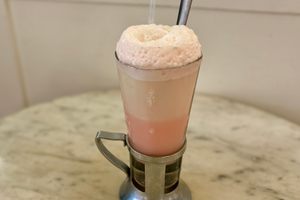
Though Cincinnati is best known for breweries, another effervescent beverage has a long history in the Queen City: the nectar soda.
Home to the oldest pharmacy college in the U.S. west of the Alleghenies, the Eclectic Medical Institute (1845-1952), and Lloyd Brothers Pharmacists, Cincinnati was long on the forefront of the pharmaceutical industry. The city had a number of apothecaries with soda fountains, as well as confectioners serving countless carbonated concoctions—some claiming to cure a variety of ailments, and others simply providing customers with something sweet and refreshing to drink.
Enter the nectar soda. The flavor is a combination of vanilla and bitter almond, and the drink is pastel pink in color—a nod to the hue of almond flowers, according to Dann Woellert, a Cincinnati food historian, etymologist, and the author of Cincinnati Candy: A Sweet History. Nicknamed the “drink of the gods,” the bitter almond flavor of nectar soda balances out what would otherwise be overly sweet vanilla, creating an addictive taste that grows on you with each sip.
Nectar sodas have been served in Cincinnati since at least the late 1870s, though, like many iconic foods and beverages, its precise origins are murky. The only other U.S. city to embrace nectar sodas was New Orleans, but unlike Cincinnati, the tradition fizzled out in the Big Easy in the mid-20th century. Plus, Woellert says that the Queen City popularized them first. “They were served in Cincinnati nearly a decade before New Orleans,” he says.
While the Cincinnati nectar soda has multiple origin stories, each crediting a different pharmacist or confectioner, Woellert has concluded that John Mullane created the flavor after traveling to Quebec City to learn the art of confectionery from a prominent Canadian candymaker. He began serving nectar sodas in his confectionery shop in downtown Cincinnati in the late 1870s.
So, why did the nectar soda end up in Cincinnati and New Orleans, of all places? Wollert suspects that the bitter almond and vanilla flavor was used by the French Acadians who settled in both Quebec City and New Orleans.
Though nectar sodas aren’t as common as they were in the early 20th century, when they could be found at countless confectioneries and pharmacy soda fountains across Cincinnati, they’re still served at establishments throughout the city and the surrounding area. Nectar sodas have been on the menu at ice cream and chocolate shop Aglamesis Brothers since it opened in Cincinnati in 1908, if not shortly thereafter. That’s according to company president and CEO Randy Young, who is also a third-generation family member.
It’s unclear when nectar sodas were added to the menu at Graeter’s, a Cincinnati ice cream and chocolate shop that opened in 1870 and now has locations throughout the city and the Midwest, but Chip Graeter, chief of retail operations and a fourth-generation family member, says that they were especially popular throughout the 1940s, 1950s and 1960s.
In a January 28, 1947 article in the Cincinnati Enquirer, Tom Moore, the head of the soda department at Dow Drug Store—which operated 32 soda fountains throughout the metropolitan area at that time—said that “nectar is one of the most popular flavors in all of their stores, and has been for many years.” Five years prior, Dow ran an ad in the same newspaper which read: “Be glad you live in Cincinnati, the only place in the country where you can enjoy a Dow double-dip nectar soda.”
Originally, nectar syrup was made by combining half-and-half or milk with water, bitter almond extract, vanilla extract and red food coloring. While Aglamesis eventually switched to a dairy-free shelf-stable syrup, Graeter's recipe has never changed—it still contains milk and needs to be refrigerated.
Both Aglamesis and Graeter’s make nectar soda by mixing nectar syrup with a dollop of whipped cream, adding a scoop or two of vanilla ice cream, then topping it off with some soda water and more whipped cream.
Though Young says that nectar sodas are most popular with older adults, they’re also a hit with members of younger generations who try them. “People who grew up with them still love them today,” Graeter says. “We still make them in all of our stores, but they're not nearly as popular today as they once were, simply because milkshakes and smoothies have taken over.”
According to Young, there is a commercially available descendant of the nectar soda. “Commercial soda companies like Barqs and others came out with their version of cream soda—a bright pink soda—which got its flavoring from nectar soda,” he explains.
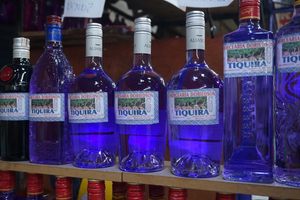
Indigenous Brazilians have fermented alcoholic beverages from the cassava root for thousands of years. These beer-like beverages go by names like cauim, caxiri, and tarubá. Fermentation is an important step in cassava processing—the raw root has chemicals that can turn into cyanide in the human body. Native peoples found that a bit of human saliva and some naturally occurring yeast could eliminate these toxins and improve the nutritious value of the tuber. When the technology of distillation arrived to the Munim River region (now in Maranhão), locals who already drank lightly alcoholic cassava beverages began to distill them. Tiquira was born.
The name tiquira is likely derived from the Tupi word tykyre meaning "to drip." But it is a curiosity that the spirit has flourished in only one Brazilian state, Maranhão. Margot Stinglwagner, founder of Guaaja Tiquira, the first modern brand to produce the spirit starting in 2016, says “It’s a spirit that is also unknown in Brazil. A few people have heard about tiquira—but usually only people who have gone to Maranhão once.” Accordingly, the state moved to declare the spirit as a piece of Cultural and Intangible Heritage in September 2023.
Part of the reason that tiquira has remained so isolated is that cachaça, Brazil’s rum, is far easier to produce. Because the rum comes from sugarcane, the sugar for fermentation is already there. “With cassava, you don’t have sugar,” Stinglwagner explains. “You must first transform the carbohydrates into sugar and then you can ferment and distill it.” To achieve this end, Guaaja Tiquira uses food enzymes instead of the traditional human saliva. Guaaja also differs from other distillers because they use full cassava roots where most tiquira moonshiners rely on processed farinha de mandioca, or cassava flour.
“The majority of people produce it illegally,” laughs Stinglwagner. “The state does nothing about it.” Outside of the urban center, tiquira is invariably a homemade product. Generally, tiquira makers don’t separate the "heads" (the first drops of liquor from a distillation, which contain harsher alcohols including toxic methanol and other pungent and volatile flavor compounds) from the "tails" (the final liquid produced from distillation, which has a low alcohol content and can have unwelcome bitter flavors), meaning the spirit is stronger and may contain more toxins and impurities. Some even macerate marijuana into the combined spirit to produce the doubly-illicit tiquiconha.
Maranhenses believe that you cannot get wet or bathe after drinking tiquira, lest you become faint or dizzy. Zelinda Machado de Castro e Lima, one of the great chroniclers of folk culture in Maranhão, has recorded other traditions surrounding the drink. Firstly, it is typical to pierce a cashew with a toothpick and soak it in a glass of tiquira for several hours. It is then sucked as a sort of boozy lollipop. She also writes about the belief that those drinking coffee should avoid tiquira, while locals say that fishermen on the coast used the liquor to sanitize wounds incurred on the job.
Finally, there is the curious question of the color of tiquira. In the tourist markets of São Luís, the spirit is always blushing a translucent violet. “They say that the color of tiquira is from tangerine leaves, but we tried to do it and the color from the leaves is not stable,” says Stinglwagner. “It is also not a strong color. The norms and laws for tiquira prohibit the addition of the leaves.” The violet color may be artificial (perhaps from food dyes), but some tiquiras do have a citrusy flavor.
Tiquira today is still largely relegated to the world of moonshining, but with the government’s recognition of the spirit and new legitimate ventures like that of Guaaja Tiquira, Brazil could be seeing more of the cassava liquor outside of its home in Maranhão.
“All the people say to me, ‘What is this new spirit?,’” says Stinglwagner. “I say, ‘It’s not a new spirit, it’s the oldest spirit from Brazil.’”
Know Before You Go
Tiquira is widely available in the downtown markets of São Luís, Maranhão. Both the local Mercado Central and touristic Mercado das Tulhas have many vendors selling tiquira. The commercial brand, Guaaja Tiquira, is also available in São Luís at Empório Fribal, in addition to Copacabana Palace and Fairmont Hotel in Rio de Janeiro, and Mocotó Bar e Restaurante in São Paulo.
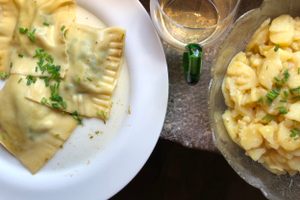
The origins of Germany’s Maultaschen are deliciously devious. Legend has it that, in the late Middle Ages, a lay brother named Jakob invented the stuffed pasta dumplings at the Maulbronn Monastery, a UNESCO World Heritage site founded in 1147 by Cistercian monks in southwest Germany.
One direct translation of Maultaschen is “mouth pockets,” though “Maul” could just as easily refer to Maulbronn. Maultaschen are usually square dumplings (though sometimes they're rolled) and can be fried in a pan or served in broth. Commonly described as Germany’s version of Italian ravioli, they allegedly emerged as a way to use up an unexpected bounty of meat that Brother Jakob stumbled upon in the forest outside the monastery walls.
The twist? Although they abhorred waste, these monks weren’t allowed to eat the meat of four-legged animals, especially during the Catholic fasting period of Lent in the spring. So Brother Jakob minced the meat with herbs and onions and wrapped everything inside pasta dough, hiding the forbidden flesh from the eyes of his fellow monks—and even from the eyes of God.
In Swabia, the region encompassing much of Baden-Württemberg and part of Bavaria where Maultaschen originated, one of the colloquial names for the food references this deception directly: Herrgottsbescheißerle means “little God-cheaters.”
Everyone in Swabia has their version of the legend with more or less embellishment. Ludwig Nestler holds a master’s degree in heritage conservation and works for the State Palaces and Gardens of Baden-Württemberg, a government organization that oversees monuments like Maulbronn Monastery. His version of the tale includes a sack of stolen meat dropped in the woods by a fleeing thief, which inspires Brother Jakob’s trickery in the kitchen. But he acknowledges that there’s no undisputed “historically correct version” of how Maultaschen came to be. Similarly, everyone in Swabia has their own Maultaschen recipe, with unique ingredients for the minced filling, called Brät.
“Traditionally the Brät is made from pork mixed with herbs, onions, and occasionally bread crumbs for texture and stability,” says Nestler. Swabia, however, “was a rather poor region with limited amounts of meat due to rather unfertile land, so being adaptive and innovative has always been a part of the people’s nature.” As Maultaschen became popular, fish and seasonal vegetables like spinach, carrots, beets, and mushrooms became common inclusions.
Today, the European Union ties Maultaschen to Swabia with a Protected Geographical Indication, which lists required ingredients the authentic product should feature, but even the necessary inclusions are pretty loose, such as “pork and/or beef and/or veal” for meat Brät and “typical regional vegetables” for meat-free Brät. It speaks to the way the dumplings developed as subsistence food, used to stretch leftovers and reduce food waste.
Today, Germans throughout the country enjoy Maultaschen in dozens of flavors in all seasons thanks to grocery stores that stock packaged varieties made by companies like Ditzingen-based Bürger, whose mascot, Erwin, is a Maultasche (the singular form of the plural Maultaschen).
But the dumplings remain most popular in southern Germany. Maulbronn Monastery offers a special tour that pairs Maultaschen with wine from the monastery’s vineyards. And many locals, including Nestler’s family, still make them from scratch on special occasions—even during Lent, when meat might otherwise be off the menu. There’s no telling if it’s a fraud good enough to fool God, but it’s worth a shot.